How to use this calculator
Calculate the expected number of independent draws needed to see every one of M equally likely types.
- Enter Number of equally likely types M. Match the units shown beside each field and review the result together with the assumptions below.
- Read the worked example below to check the expected input format and result.
- Compare another scenario by changing one input at a time. Use Reset to return to the starting values.
How Coupon collector expected draws calculator works
Calculate the expected number of independent draws needed to see every one of M equally likely types.
Inputs and units
- Number of equally likely types M: Enter a positive whole-number count M of distinct types, each selected with equal probability on every independent draw.
Formula and method
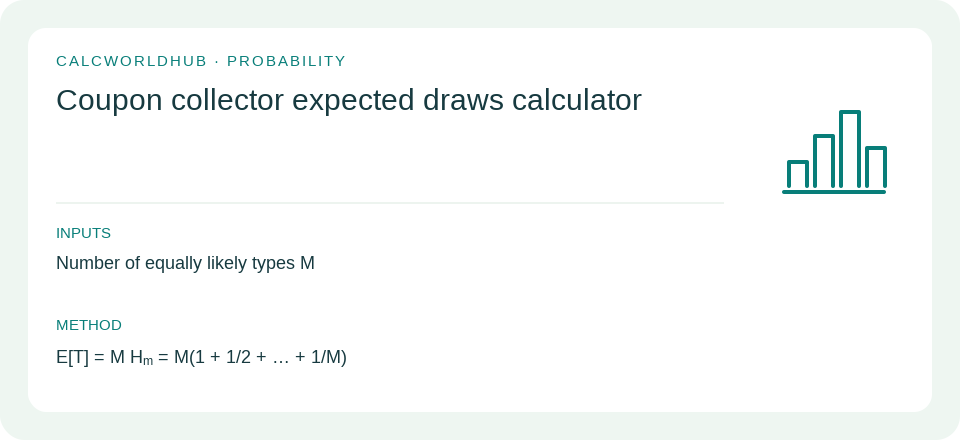
E[T] = M Hₘ = M(1 + 1/2 + … + 1/M)
Worked example
For M=10, E[T]=10H₁₀≈29.28968 draws; the expectation is not a guarantee that collection finishes by this number.
Interpreting the result
This is a long-run average over repeated collection experiments. The last few unseen types account for much of the expected waiting time.
Assumptions and limits
Assumes independent draws and equal probability for every type. Unequal probabilities can make the expected waiting time substantially larger; the output is an expectation, not a percentile or stopping-time guarantee.
Sources and method
- The equal-probability coupon collector expectation is M times the Mth harmonic number. Tufts University: coupon collector problem
Frequently asked questions
Why is the expected number of draws larger than M?
Repeated types occur before the last missing type appears, and rare remaining gaps take longer to fill.
Does the answer mean I will finish by that draw count?
No. An expected value is an average over repetitions, not a deadline or probability guarantee.
How do I use the Coupon collector expected draws calculator?
Enter Number of equally likely types M. Match the units shown beside each field and review the result together with the assumptions below.
What is a worked example of Coupon collector expected draws?
For M=10, E[T]=10H₁₀≈29.28968 draws; the expectation is not a guarantee that collection finishes by this number.
What does the Coupon collector expected draws calculator calculate?
Calculate the expected number of independent draws needed to see every one of M equally likely types.