How to use this calculator
Calculate runs conceded per six-ball over from runs and legal balls bowled.
- Enter Runs conceded by bowler, Legal balls bowled. Match the units shown beside each field and review the result together with the assumptions below.
- Read the worked example below to check the expected input format and result.
- Compare another scenario by changing one input at a time. Use Reset to return to the starting values.
How this calculation works
Bowling economy rate summarizes the scoring rate allowed by a bowler. Enter runs conceded and legal balls bowled for the same spell, innings, or season; overs are derived from legal-ball count rather than cricket notation such as 4.2 overs.
Inputs and units
runs— Runs conceded by bowler- Runs charged to the bowler in the selected sample.
balls— Legal balls bowled- Legal deliveries in the same sample; exclude wides and no-balls.
Formula
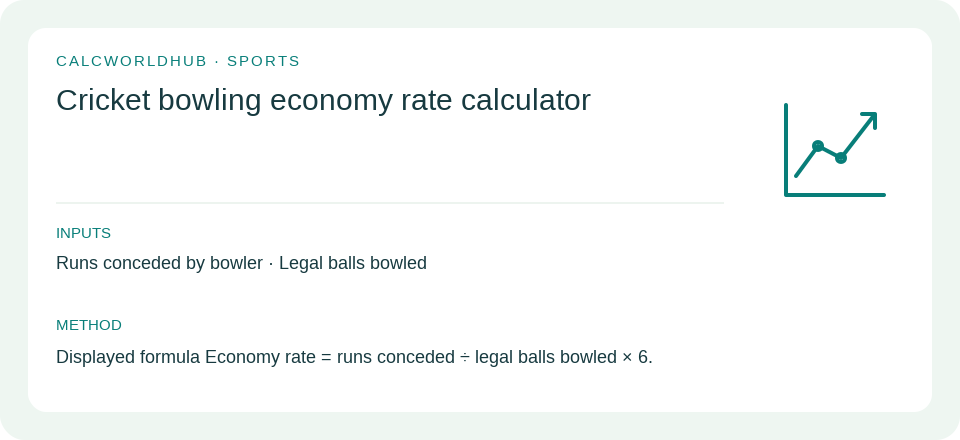
Economy rate = runs conceded ÷ legal balls bowled × 6.
Worked example
A bowler who concedes 32 runs from 24 legal balls has an economy rate of 32 ÷ 24 × 6 = 8 runs per over.
Assumptions and limits
Scoring conventions for byes, leg-byes, penalties, and bowler chargeability depend on the scorebook. Use the runs charged to the bowler for official comparison.
Frequently asked questions
How should I enter 4.2 overs?
Cricket notation 4.2 means 4 overs plus 2 legal balls, or 26 legal balls; enter 26 rather than 4.2.
Do wides count in the over?
Wides add runs but are not legal balls; use the official legal-ball count.
Does the metric use team runs or runs charged to the bowler?
Use runs credited against the bowler under the scorekeeping rules, not necessarily every run scored while the bowler was active.
How do I use the Cricket bowling economy rate calculator?
Enter Runs conceded by bowler, Legal balls bowled. Match the units shown beside each field and review the result together with the assumptions below.
What is a worked example of Cricket bowling economy rate?
A bowler who concedes 32 runs from 24 legal balls has an economy rate of 32 ÷ 24 × 6 = 8 runs per over.
Read our calculation methodology.