How to use this calculator
Compare a cricket team’s runs scored per over with runs conceded per over across the same match set.
- Enter Runs scored by team, Official balls faced, Runs conceded, Official balls bowled. Match the units shown beside each field and review the result together with the assumptions below.
- Read the worked example below to check the expected input format and result.
- Compare another scenario by changing one input at a time. Use Reset to return to the starting values.
How this calculation works
Net run rate (NRR) is the difference between a team’s scoring rate and its opponents’ scoring rate across a competition sample. Enter runs and legal balls for both sides using the official overs allocation; when a side is all out before using its quota, use the quota-adjusted balls required by the competition rules.
Inputs and units
forRuns— Runs scored by team- Aggregate runs scored in the selected match set.
forBalls— Official balls faced- Legal-ball equivalent after applying competition overs rules.
againstRuns— Runs conceded- Aggregate runs conceded in the same match set.
againstBalls— Official balls bowled- Legal-ball equivalent after applying competition overs rules.
Formula
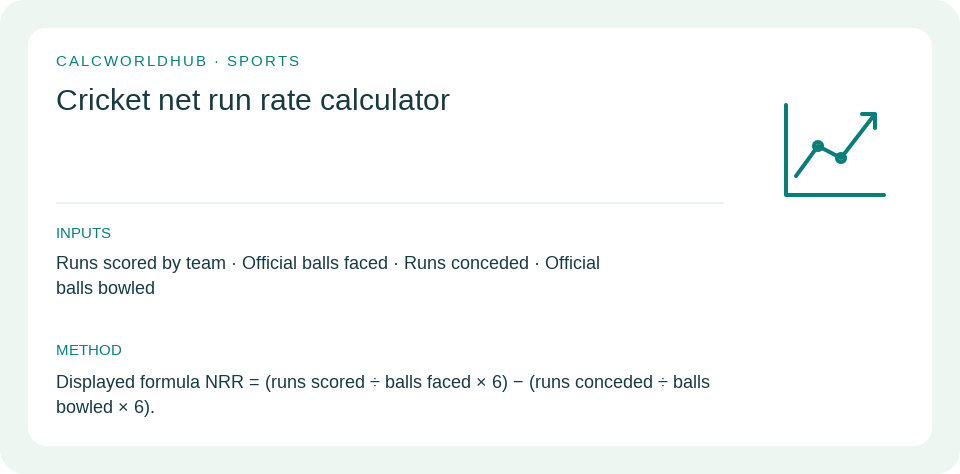
NRR = (runs scored ÷ balls faced × 6) − (runs conceded ÷ balls bowled × 6).
Worked example
A team scoring 300 runs from 300 balls scores at 6.0 runs per over; conceding 270 from 300 balls is 5.4 per over; NRR = 6.0 − 5.4 = +0.6.
Assumptions and limits
Tournament rules can prescribe special treatment for all-outs, incomplete innings, penalties, or abandoned matches. This calculator does not determine standings or tie-break eligibility.
Frequently asked questions
How are overs converted from balls?
Divide legal-ball counts by six; enter the competition-adjusted totals rather than cricket notation such as 49.3 overs.
What if a team is all out early?
Use the full quota-adjusted balls specified by the competition’s NRR rules when applicable.
Can NRR alone decide tournament qualification?
No. Competition regulations determine tie-break order and any adjustments for abandoned or shortened matches.
How do I use the Cricket net run rate calculator?
Enter Runs scored by team, Official balls faced, Runs conceded, Official balls bowled. Match the units shown beside each field and review the result together with the assumptions below.
What is a worked example of Cricket net run rate?
A team scoring 300 runs from 300 balls scores at 6.0 runs per over; conceding 270 from 300 balls is 5.4 per over; NRR = 6.0 − 5.4 = +0.6.
Read our calculation methodology.