Critical angle calculator
Find the critical incidence angle for total internal reflection at a boundary. Enter your values below to see the result and method.
inputs.
Related calculators
These tools cover nearby questions while keeping this page focused on its own calculation.
How to use this calculator
Free Critical angle calculator. Find the critical incidence angle for total internal reflection at a boundary. Formula, example, and assumptions explained.
- Enter Higher refractive index n₁, Lower refractive index n₂. Match the units shown beside each field and review the result together with the assumptions below.
- Read the worked example below to check the expected input format and result.
- Compare another scenario by changing one input at a time. Use Reset to return to the starting values.
Set the physical situation and reference frame
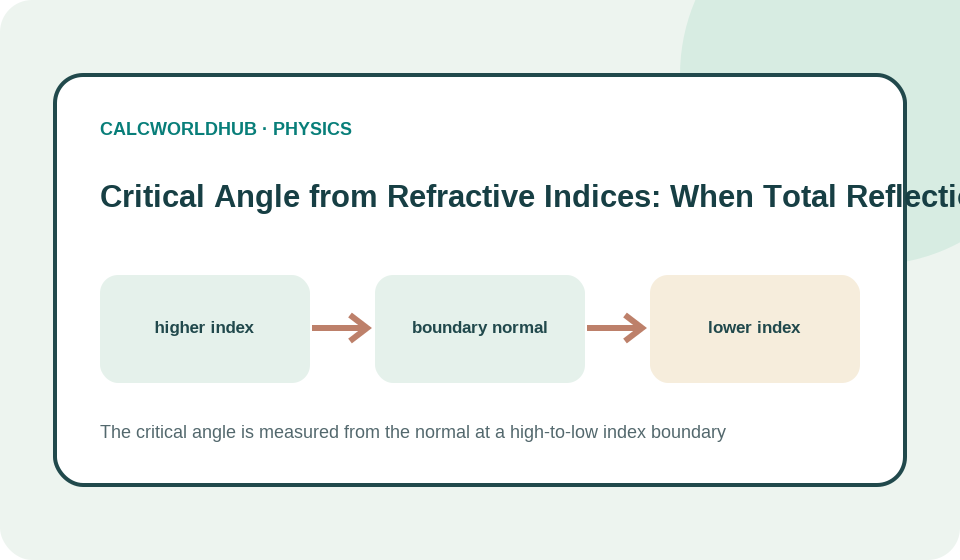
For light traveling from a higher refractive index n₁ into a lower index n₂, calculate the incidence angle from the normal at which the refracted ray reaches 90°.
Inputs and units
Refractive indices are dimensionless and should use the same wavelength and medium convention; the incident-side value n₁ must exceed n₂.
- Higher refractive index n₁: Index on the side from which the ray approaches the interface.
- Lower refractive index n₂: Index on the transmitted side; total internal reflection requires n₂ < n₁.
Equation and worked example
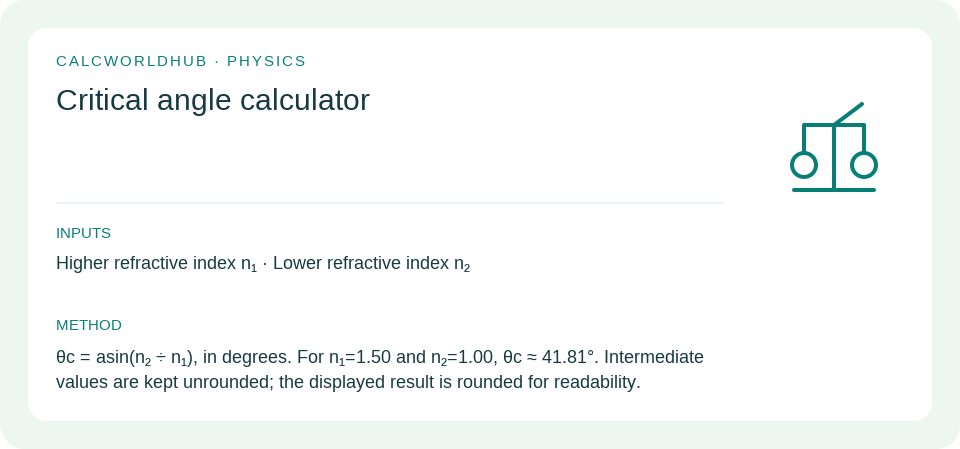
θc = asin(n₂ ÷ n₁), in degrees.
For n₁=1.50 and n₂=1.00, θc ≈ 41.81°.
Intermediate values are kept unrounded; the displayed result is rounded for readability.
What the result represents
The angle is measured from the normal inside the higher-index medium. Incidence above this angle gives total internal reflection in the ideal interface model.
Assumptions and limitations
Total internal reflection requires travel from higher to lower refractive index; angle is measured from the normal.
Frequently asked questions
Which physical quantities define the critical angle?
Refractive indices are dimensionless and should use the same wavelength and medium convention; the incident-side value n₁ must exceed n₂.
What idealization is used by the critical angle?
Total internal reflection requires travel from higher to lower refractive index; angle is measured from the normal.
How do I use the Critical angle calculator?
Enter Higher refractive index n₁, Lower refractive index n₂. Match the units shown beside each field and review the result together with the assumptions below.
What is a worked example of Critical angle?
θc = asin(n₂ ÷ n₁), in degrees. For n₁=1.50 and n₂=1.00, θc ≈ 41.81°. Intermediate values are kept unrounded; the displayed result is rounded for readability.
What does the Critical angle calculator calculate?
Free Critical angle calculator. Find the critical incidence angle for total internal reflection at a boundary. Formula, example, and assumptions explained.
Read the calculation methodology and privacy policy.
Source: OpenStax, Total Internal Reflection.