
Identify the direction of light travel
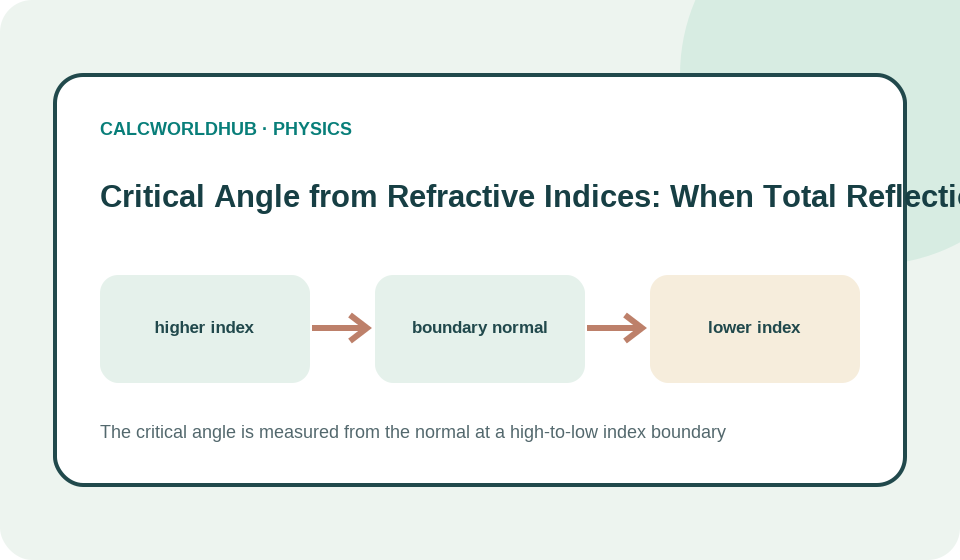
The direction of travel matters. A critical angle exists for the transition from the higher refractive index n₁ to the lower index n₂, with n₁ greater than n₂. If light travels the other way, from lower to higher index, total internal reflection does not occur at that boundary under the simple ray model. Check which medium the incident ray is actually in.
Use the higher and lower indices
Enter dimensionless refractive indices for the two media. The calculator labels the higher index as n₁ and the lower as n₂; both should be positive and n₁ must exceed n₂. Values depend on material and wavelength, so use indices appropriate to the light source and medium conditions instead of combining handbook values measured at different wavelengths.
Apply the inverse sine relation
Snell’s law at the limiting condition gives sin θc = n₂/n₁, so θc = sin⁻¹(n₂/n₁). The inverse sine returns the angle in radians mathematically, and the calculator displays degrees. Because n₂/n₁ is below one for the allowed ordering, the angle is defined. A ratio at or above one has no real critical angle in this setup.
Measure the angle from the normal
The incidence angle is measured from the normal, an imaginary line perpendicular to the interface. If a diagram marks the ray angle from the surface, convert it by subtracting from 90 degrees before comparing with θc. This convention is a common source of errors in optics: the same ray has complementary angles relative to the normal and the surface.
Connect the threshold to total reflection
At the critical angle, the refracted ray grazes the boundary. For a larger incidence angle in the higher-index medium, Snell’s law has no propagating refracted-ray solution and the ideal model predicts total internal reflection. At smaller angles, some light refracts into the second medium; the critical angle is a threshold, not a general reflectance percentage.
For a medium pair with n₂ close to n₁, the ratio approaches one and the critical angle approaches 90 degrees. If the indices are nearly equal, the boundary offers little index contrast for total internal reflection. This qualitative check helps catch a reversed pair: swapping high and low indices can make the ratio exceed one and remove the real angle rather than produce a meaningful value.
Refractive index is not a universal number for a material independent of conditions. Dispersion means that different wavelengths can have different indices, so white light may have a range of threshold angles and can separate into colors. Temperature, composition, and measurement conditions may also matter for precision work. State the wavelength and source of both indices when comparing the estimate with an optical design, especially near the threshold where a small index change shifts the angle.
Worked examples
The arcsine is evaluated on n₂/n₁ and the final angle is reported in degrees.
Glass to air using a simple index pair
Inputs: Higher-index medium n₁ = 1.50; lower-index medium n₂ = 1.00.
Calculation: θc = sin⁻¹(n₂/n₁) = sin⁻¹(1.00/1.50) = sin⁻¹(0.6666667) ≈ 41.8103°.
The critical angle from the normal is approximately 41.81°.
A different transparent-medium pair
Inputs: Higher index n₁ = 1.62; lower index n₂ = 1.33.
Calculation: θc = sin⁻¹(1.33/1.62) = sin⁻¹(0.8209877) ≈ 55.1838°.
The threshold angle is about 55.18 degrees from the normal.

Limits of an index-only estimate
The result can help estimate whether a ray in a prism, fiber, or transparent material approaches the reflection threshold. It does not calculate reflectance, attenuation, polarization, or the effect of a finite coating. Real optical systems may include absorption, surface roughness, dispersion, and geometry that require additional analysis.
Refractive index varies with wavelength and can vary with temperature, pressure, and material composition. If n₁ and n₂ are rounded, the output angle inherits that input precision. Near the threshold, small index differences can produce a material change in the angle, so report the source and wavelength of the indices when accuracy matters.