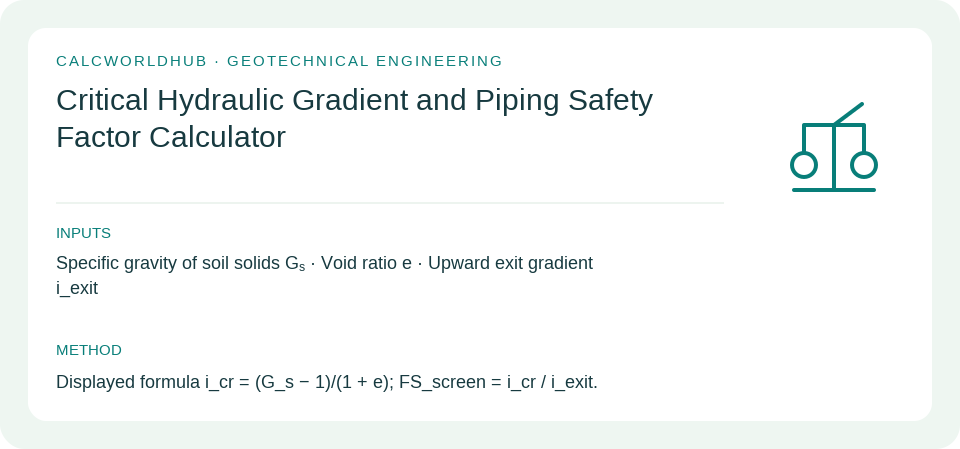
How to use this calculator
Estimate the Terzaghi critical upward gradient and a piping or heave screening factor of safety from soil properties.
- Enter Specific gravity of soil solids Gₛ, Void ratio e, Upward exit gradient i_exit. Match the units shown beside each field and review the result together with the assumptions below.
- Read the worked example below to check the expected input format and result.
- Compare another scenario by changing one input at a time. Use Reset to return to the starting values.
How this calculation works
Upward seepage reduces the effective weight holding saturated cohesionless soil in place. The Terzaghi critical hydraulic gradient is estimated from the specific gravity of soil solids and void ratio; dividing it by an entered upward exit gradient gives a simple screening factor. Use an exit gradient from an appropriate seepage analysis and treat internal erosion mechanisms separately.
Inputs and units
specificGravity— Specific gravity of soil solids Gₛ- Use the dimensionless grain-solids specific gravity, not bulk soil specific gravity.
voidRatio— Void ratio e- Enter void volume divided by solid volume for the soil layer.
exitGradient— Upward exit gradient i_exit- Enter the local upward gradient at the seepage exit from a separate seepage analysis.
Formula
i_cr = (G_s − 1)/(1 + e); FS_screen = i_cr / i_exit.
Method
Calculate the critical gradient from soil-solids specific gravity G_s and void ratio e. Divide it by the upward exit gradient i_exit from a flow-net or other seepage analysis. The two gradients are dimensionless.
Worked example
For Gₛ = 2.65, e = 0.65, and i_exit = 0.50, i_cr = 1.0000 and the screening factor of safety is 2.000.
Assumptions and limits
This local heave screen does not predict backward-erosion progression, filter performance, soil layering, anisotropy, cohesion, or project-specific acceptance criteria. It is not a dam or excavation design approval.
Frequently asked questions
What does the critical hydraulic gradient represent?
It is the idealized upward gradient at which seepage force balances the submerged weight of a cohesionless soil mass in the Terzaghi model.
Where should the exit gradient come from?
Use a local upward gradient from a flow net, numerical seepage model, or field interpretation suited to the actual geometry.
Does this factor of safety predict piping progression?
No. Backward erosion, filters, soil structure, layering, and project-specific criteria need separate evaluation.
How do I use the Critical Hydraulic Gradient and Piping Safety Factor Calculator?
Enter Specific gravity of soil solids Gₛ, Void ratio e, Upward exit gradient i_exit. Match the units shown beside each field and review the result together with the assumptions below.
What is a worked example of Critical Hydraulic Gradient and Piping Safety Factor?
For Gₛ = 2.65, e = 0.65, and i_exit = 0.50, i_cr = 1.0000 and the screening factor of safety is 2.000.
Reference: FEMA P-1032 seepage and internal-erosion guidance on critical gradients and exit-gradient factors of safety. See our calculation methodology.