How to use this calculator
Locate a granular soil between measured loose and dense void-ratio reference states without confusing relative density with Proctor compaction.
- Enter In situ void ratio, Maximum void ratio, Minimum void ratio, Solids specific gravity. Match the units shown beside each field and review the result together with the assumptions below.
- Read the worked example below to check the expected input format and result.
- Compare another scenario by changing one input at a time. Use Reset to return to the starting values.
Granular soil relative density from void ratio bounds explained
A numerical walkthrough
In situ void ratio = 0.65; Maximum void ratio = 0.9; Minimum void ratio = 0.45; Solids specific gravity = 2.65.
- Relative density Dr: 55.555556 %
- Corresponding dry density: 1.606061 Mg/m³
- Porosity: 39.393939 %
For e=0.65, emax=0.90 and emin=0.45, relative density is about 55.56%. With Gs=2.65, the corresponding dry density is about 1.6061 Mg/m³.
The model behind the numbers
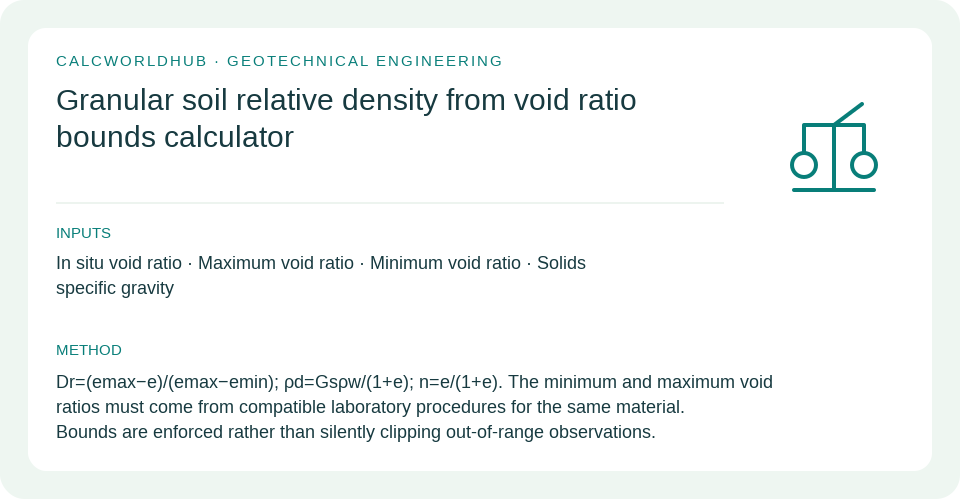
Dr=(emax−e)/(emax−emin); ρd=Gsρw/(1+e); n=e/(1+e).
The minimum and maximum void ratios must come from compatible laboratory procedures for the same material. Bounds are enforced rather than silently clipping out-of-range observations.
What to enter
e— In situ void ratio- Field void ratio of the granular soil.
emax— Maximum void ratio- Void ratio at the specified loosest laboratory reference state.
emin— Minimum void ratio- Void ratio at the specified densest laboratory reference state.
Gs— Solids specific gravity- Solids-to-water density ratio for the companion dry-density output.
Interpreting the result
Granular material with meaningful limiting density tests; cementation, crushing, segregation and inconsistent sample gradation can invalidate the comparison. Educational model; this is not a code-compliant design check.
Reading the outputs
Dr and porosity are percentages; dry density uses a 1 Mg/m³ water-density reference.
Frequently asked questions
Why reject Dr below 0 or above 100?
The input lies outside the supplied reference bounds and should be reconciled before interpreting this model.
Can Dr be inferred from porosity alone?
No. The loose and dense reference states are additionally required.
Should a Proctor maximum replace emin?
No. Those are different tests and reference concepts.
How do I use the Granular soil relative density from void ratio bounds calculator?
Enter In situ void ratio, Maximum void ratio, Minimum void ratio, Solids specific gravity. Match the units shown beside each field and review the result together with the assumptions below.
What is a worked example of Granular soil relative density from void ratio bounds?
In situ void ratio = 0.65; Maximum void ratio = 0.9; Minimum void ratio = 0.45; Solids specific gravity = 2.65. Relative density Dr: 55.555556 % Corresponding dry density: 1.606061 Mg/m³ Porosity: 39.393939 % For e=0.65, emax=0.90 and emin=0.45, relative density is about 55.56%. With Gs=2.65, the corresponding dry density is about 1.6061 Mg/m³.
Background or definition reference: FHWA Soils and Foundations Reference Manual, Volume I.
Read our calculation methodology.