How to use this calculator
Compare a field dry-density observation with a specified laboratory compaction maximum and flag a physically inconsistent zero-air-voids result.
- Enter Field wet density (Mg/m³), Water content by dry mass (%), Laboratory maximum dry density (Mg/m³), Solids specific gravity. Match the units shown beside each field and review the result together with the assumptions below.
- Read the worked example below to check the expected input format and result.
- Compare another scenario by changing one input at a time. Use Reset to return to the starting values.
Field relative compaction and zero air void check explained
Field relative compaction compares in-place dry density with a laboratory maximum dry density from a specified compaction test. The zero-air-voids result is a separate theoretical ceiling at the entered water content and solids specific gravity; neither output replaces a field acceptance specification.
Inputs, symbols, and units
rho— Field wet density (Mg/m³)- Measured bulk density including water.
w— Water content by dry mass (%)- Water mass divided by dry soil mass, expressed as a percentage.
rmax— Laboratory maximum dry density (Mg/m³)- Reference peak dry density from the specified compaction test energy.
Gs— Solids specific gravity- Soil-solids density divided by water density, used only for the zero-air-voids check.
Formula and method
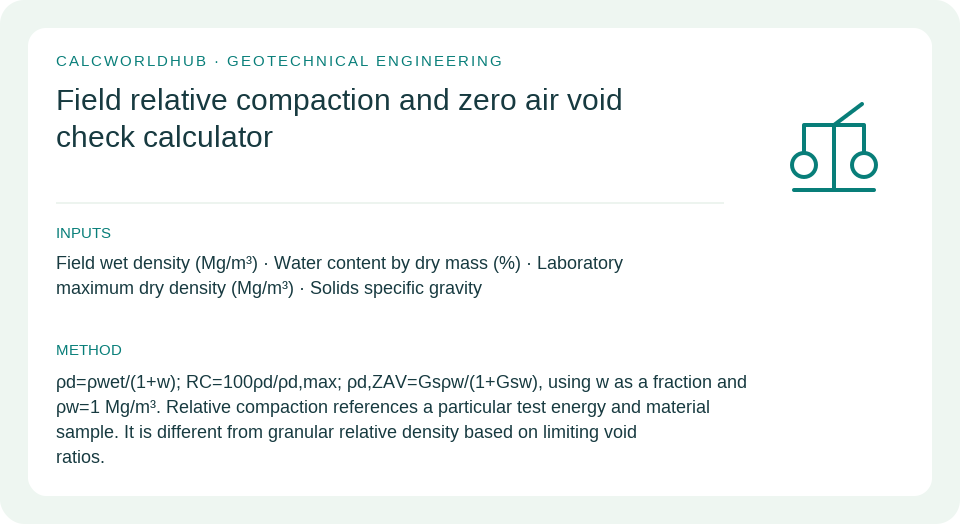
ρd=ρwet/(1+w); RC=100ρd/ρd,max; ρd,ZAV=Gsρw/(1+Gsw), using w as a fraction and ρw=1 Mg/m³.
Relative compaction references a particular test energy and material sample. It is different from granular relative density based on limiting void ratios.
A worked scenario
Field wet density (Mg/m³) = 2.05; Water content by dry mass (%) = 12; Laboratory maximum dry density (Mg/m³) = 1.9; Solids specific gravity = 2.65.
- Relative compaction: 96.334586 %
- Field dry density: 1.830357 Mg/m³
- Zero-air-voids dry density: 2.010622 Mg/m³
A field wet density of 2.05 Mg/m³ at 12% water content gives dry density 1.83036 Mg/m³; compared with a 1.90 Mg/m³ laboratory maximum this is about 96.33%.
Assumptions and edge cases
Assumes water-density reference 1 Mg/m³ and consistent dry-mass water content. Oversize corrections, material variability and field-test calibration are not modeled. Educational model; this is not a code-compliant design check.
Reading the outputs
Relative compaction is percent; field and theoretical zero-air-voids dry densities are Mg/m³.
Frequently asked questions
Can relative compaction exceed 100%?
It can exceed a particular laboratory peak if field conditions or material differ, but it cannot exceed the zero-air-voids physical bound.
Is relative compaction the same as relative density Dr?
No. Dr uses maximum and minimum void ratios of granular soil.
Why does the chosen laboratory test matter?
Different compaction energies can produce different reference maximum dry densities and optimum moisture contents.
How do I use the Field relative compaction and zero air void check calculator?
Enter Field wet density (Mg/m³), Water content by dry mass (%), Laboratory maximum dry density (Mg/m³), Solids specific gravity. Match the units shown beside each field and review the result together with the assumptions below.
What is a worked example of Field relative compaction and zero air void check?
Field wet density (Mg/m³) = 2.05; Water content by dry mass (%) = 12; Laboratory maximum dry density (Mg/m³) = 1.9; Solids specific gravity = 2.65. Relative compaction: 96.334586 % Field dry density: 1.830357 Mg/m³ Zero-air-voids dry density: 2.010622 Mg/m³ A field wet density of 2.05 Mg/m³ at 12% water content gives dry density 1.83036 Mg/m³; compared with a 1.90 Mg/m³ laboratory maximum this is about 96.33%.
Background or definition reference: FHWA Soils and Foundations Reference Manual, Volume I.
Read our calculation methodology.