How to use this calculator
Budget water for a stockpile conditioning operation using dry-solids conservation and an explicit application-loss allowance.
- Enter Current wet soil mass (tonnes), Current dry-mass water content (%), Target dry-mass water content (%), Fraction of added water lost. Match the units shown beside each field and review the result together with the assumptions below.
- Read the worked example below to check the expected input format and result.
- Compare another scenario by changing one input at a time. Use Reset to return to the starting values.
Earthwork moisture conditioning water mass explained
How the calculation works
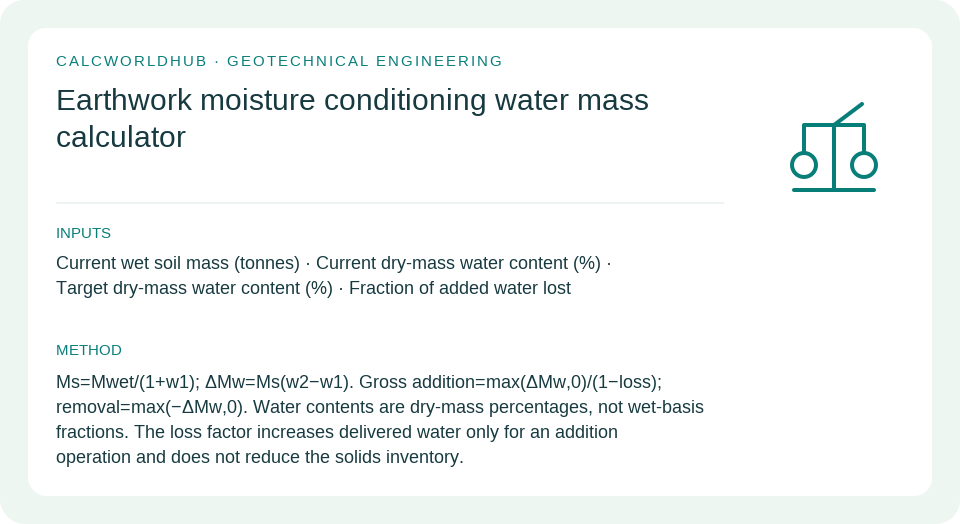
Ms=Mwet/(1+w1); ΔMw=Ms(w2−w1). Gross addition=max(ΔMw,0)/(1−loss); removal=max(−ΔMw,0).
Water contents are dry-mass percentages, not wet-basis fractions. The loss factor increases delivered water only for an addition operation and does not reduce the solids inventory.
Set up the calculation
M— Current wet soil mass (tonnes)- Total current soil mass including its existing water.
w1— Current dry-mass water content (%)- Initial water mass divided by dry solids mass.
w2— Target dry-mass water content (%)- Desired water content on the same dry-solids basis.
loss— Fraction of added water lost- Loss fraction applies only when water must be added; evaporation removal is reported separately.
Limits of this model
Uniform stockpile moisture, no solids loss, no chemical consumption or rainfall and constant water density. Mixing uniformity and compaction acceptance are separate issues. Educational model; this is not a code-compliant design check.
Check this example
Current wet soil mass (tonnes) = 120; Current dry-mass water content (%) = 8; Target dry-mass water content (%) = 13; Fraction of added water lost = 0.1.
- Gross water to add: 6.17284 m³ at 1 t/m³
- Water to remove: 0 tonnes
- Dry soil solids mass: 111.111111 tonnes
- Target net wet soil mass: 125.555556 tonnes
A 120 tonne stockpile at 8% water content contains 111.111 tonnes dry solids. Raising it to 13% needs 5.556 tonnes retained water, or 6.173 m³ delivered with 10% loss.
Reading the outputs
Gross added water uses 1 tonne/m³ density; required removal and dry/target wet masses are tonnes.
Source
FHWA, Geotechnical Engineering Circular No. 5, Soil Preparation and Properties. Defines soil water content relative to dry soil mass and explains moisture-density testing.
Frequently asked questions
Can the target be below the current water content?
Yes. The page reports removal rather than a negative water addition.
Does the loss fraction apply to drying?
No. It represents water lost during addition; drying efficiency needs a separate process model.
Is the target wet mass the delivered mass including losses?
No. It includes only the retained water at the target moisture content.
How do I use the Earthwork moisture conditioning water mass calculator?
Enter Current wet soil mass (tonnes), Current dry-mass water content (%), Target dry-mass water content (%), Fraction of added water lost. Match the units shown beside each field and review the result together with the assumptions below.
What is a worked example of Earthwork moisture conditioning water mass?
Current wet soil mass (tonnes) = 120; Current dry-mass water content (%) = 8; Target dry-mass water content (%) = 13; Fraction of added water lost = 0.1. Gross water to add: 6.17284 m³ at 1 t/m³ Water to remove: 0 tonnes Dry soil solids mass: 111.111111 tonnes Target net wet soil mass: 125.555556 tonnes A 120 tonne stockpile at 8% water content contains 111.111 tonnes dry solids. Raising it to 13% needs 5.556 tonnes retained water, or 6.173 m³ delivered with 10% loss.
Read our calculation methodology.