How to use this calculator
Estimate critical swimming speed and pace per 100 metres from 200 m and 400 m time-trial results.
- Enter 200 m time (s), 400 m time (s). Match the units shown beside each field and review the result together with the assumptions below.
- Read the worked example below to check the expected input format and result.
- Compare another scenario by changing one input at a time. Use Reset to return to the starting values.
How this calculation works
The two-distance critical-speed method uses the slope between distance and time for two maximal swim trials. A 200 m and 400 m pair yields an estimated sustainable-speed marker for training comparisons, not a guarantee of race pace or an individual physiological threshold.
Inputs and units
t200— 200 m time (s)- Elapsed time for a maximal 200 m swim trial.
t400— 400 m time (s)- Elapsed time for a comparable maximal 400 m trial; must exceed the 200 m time.
Formula
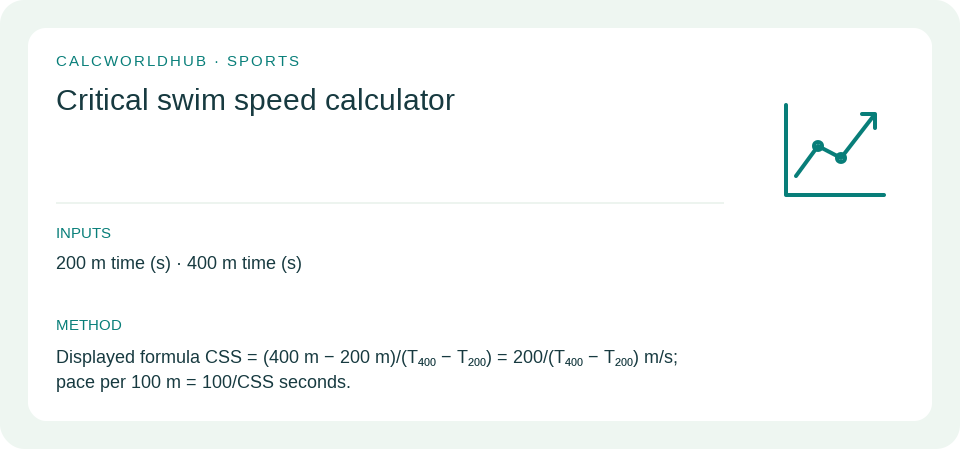
CSS = (400 m − 200 m)/(T₄₀₀ − T₂₀₀) = 200/(T₄₀₀ − T₂₀₀) m/s; pace per 100 m = 100/CSS seconds.
Method
Enter elapsed times in seconds. Divide the 200 m distance gap by the difference between the 400 m and 200 m times, then convert the resulting speed to an equivalent 100 m pace and km/h.
Worked example
If the 200 m trial takes 160 s and the 400 m trial takes 340 s, CSS = 200/(340−160) ≈ 1.111 m/s, equivalent to 90 seconds per 100 m (1:30).
Assumptions and limits
Uses the two-distance linear critical-speed estimate and assumes both trials are maximal, comparable efforts with correct timing and adequate recovery. Stroke, pool length, turns, pacing, and fatigue affect results; the estimate is training guidance and is not interchangeable with a laboratory threshold test.
Frequently asked questions
How should the two times be collected?
Use comparable, hard time trials for 200 m and 400 m in the same stroke and pool conditions, with sufficient recovery to perform both well.
Is CSS the same as a guaranteed threshold pace?
No. It is an estimate from a two-distance model and can differ from an individual metabolic threshold or sustainable race pace.
Can I enter yard times?
The formula uses the distance difference in metres. For yard trials, convert both distances and interpret the resulting pace per 100 m, or use a distance-matched model with the relevant units.
How do I use the Critical swim speed calculator?
Enter 200 m time (s), 400 m time (s). Match the units shown beside each field and review the result together with the assumptions below.
What is a worked example of Critical swim speed?
If the 200 m trial takes 160 s and the 400 m trial takes 340 s, CSS = 200/(340−160) ≈ 1.111 m/s, equivalent to 90 seconds per 100 m (1:30).
Reference: Original PubMed study of critical swimming velocity. See our calculation methodology.