Race time projection calculator
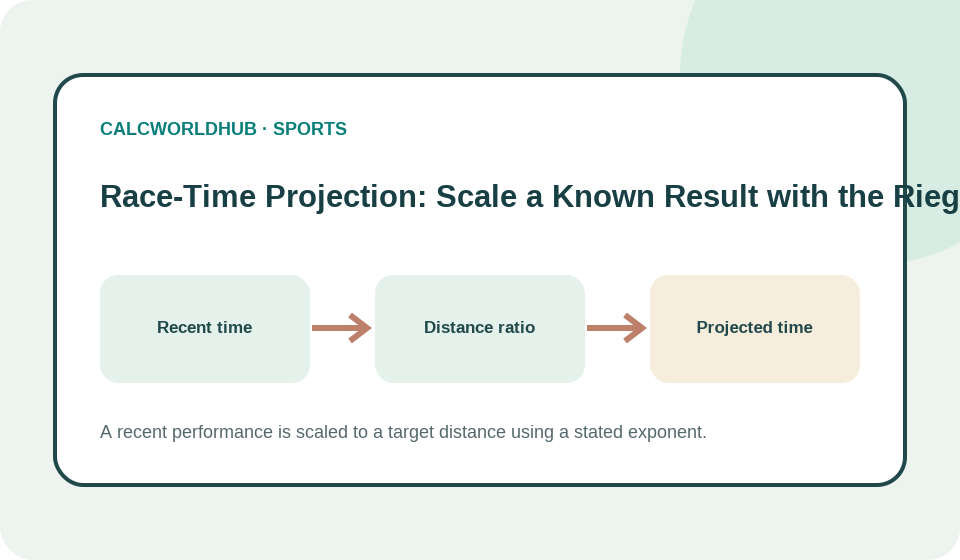
The projection scales a recent race time by the ratio between target and recent distance. It is a comparison model, not a personalized performance promise.
Calculator
How to use this calculator
Project a target-distance race time from a recent performance using an editable distance exponent and a worked example.
- Recent time (minutes) Recent distance (km) Target distance (km) Distance exponent
- Compare the worked example with your inputs and result.
- Compare another scenario by changing one input at a time. Use Reset to return to the starting values.
Race time projection calculator
The projection scales a recent race time by the ratio between target and recent distance. It is a comparison model, not a personalized performance promise.
Inputs and units
- Recent time (minutes)
- Recent distance (km)
- Target distance (km)
- Distance exponent
Formula and method
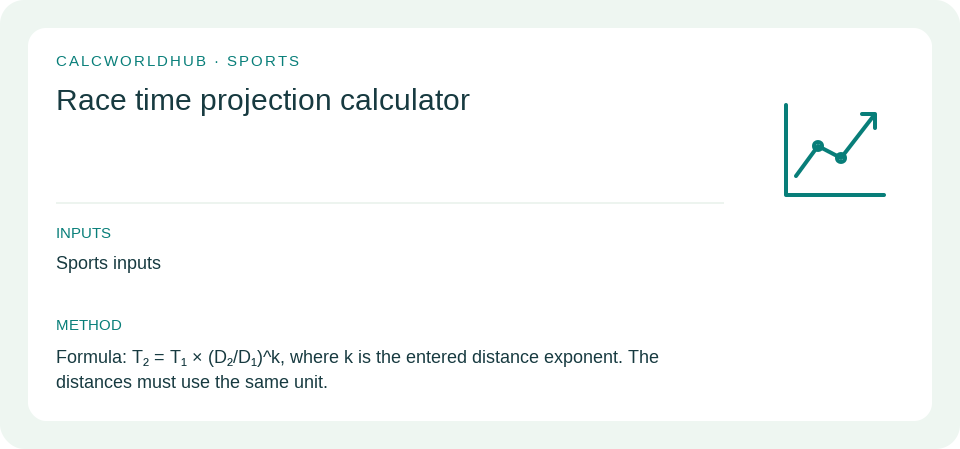
Formula: T₂ = T₁ × (D₂/D₁)^k, where k is the entered distance exponent. The distances must use the same unit.
Worked example
A 25-minute 5 km time projected to 10 km with k = 1.06 gives 25 × (10/5)^1.06 ≈ 52.12 minutes.
Interpreting the result
The estimate assumes the same athlete and broadly comparable preparation and course conditions. A larger exponent predicts more time growth as distance increases.
Assumptions and limits
The exponent is not universal. Training, terrain, weather, pacing, and event distance affect performance; research has found common formulas can underestimate marathon times for many recreational runners.
Sources and method notes
- The study evaluates the Riegel prediction formula and reports that it can underestimate marathon times for many recreational runners. Peer-reviewed study of recreational runner race-time predictions
Frequently asked questions
What does the exponent control?
It controls how strongly projected time grows as target distance increases; the default is an editable assumption.
Should I treat a marathon estimate as exact?
No. Long-distance predictions can miss individual endurance limits and preparation differences.
How do I use the Race time projection calculator?
Recent time (minutes) Recent distance (km) Target distance (km) Distance exponent
What is a worked example of Race time projection?
A 25-minute 5 km time projected to 10 km with k = 1.06 gives 25 × (10/5)^1.06 ≈ 52.12 minutes.
What does the Race time projection calculator calculate?
Project a target-distance race time from a recent performance using an editable distance exponent and a worked example.
See the calculation methodology.
Good calculators show their work.
CalcWorldHub is built around clear inputs and visible assumptions. Results are estimates for planning; check official sources or your provider’s terms when exact figures matter.