
Why normalize a swim to 100 metres
Total race or training time depends on how far you swam. Pace expresses that time against a standard distance, which helps compare different sets or performances at a glance. This calculator reports an average per 100 metres, a convenient unit for metric pool records and training notes.
An average pace does not show how the swim unfolded. A swimmer may start quickly and fade, or hold steady splits, yet both swims can have the same total time and distance. Use lap or split records when pacing changes matter; the single result here is a summary of the whole entered swim.
Enter distance and elapsed minutes
The distance field is metres swum, while elapsed time is entered in minutes. Record the distance actually completed, not the planned set length if a repetition was cut short. The time may contain a decimal fraction of a minute; for example, 13.5 minutes is thirteen minutes and thirty seconds.
Keep course length and conditions with your record. A 400-metre swim in a short-course pool includes more turns than a 400-metre swim in a long-course pool. The pace arithmetic treats the metres alike, but turns, walls, open-water conditions, stroke, equipment, and timing method can affect how meaningful a comparison is.
Convert total time into pace
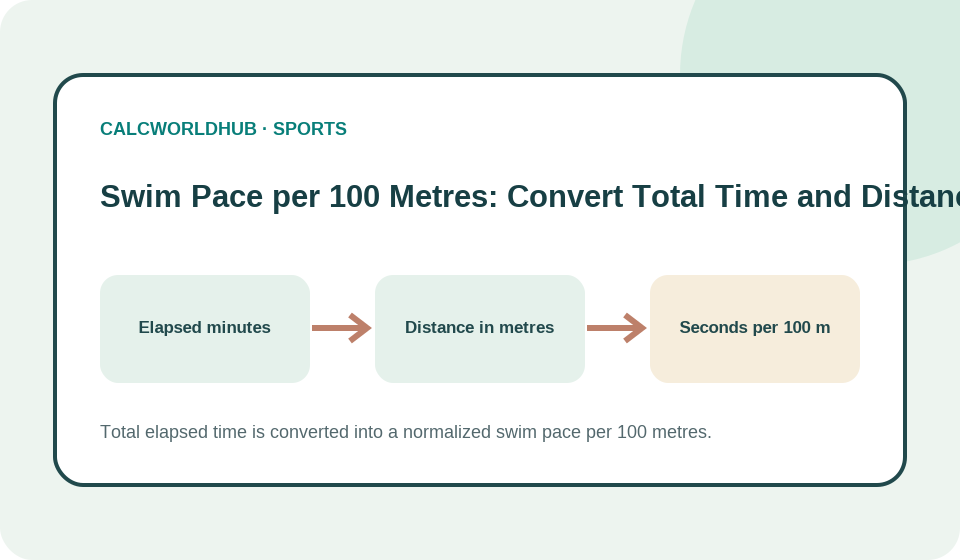
The calculator first converts minutes to seconds by multiplying by 60. It divides elapsed seconds by total metres to find seconds per metre, then multiplies by 100 to express seconds per 100 metres. The units cancel to leave seconds per 100 m.
To read a result expressed in seconds, divide by 60 to find whole minutes and use the remainder as seconds. The calculator formats the average as a pace; it does not calculate a target split, predict a race result, or identify the fastest segment.
Use consistent measurements for comparisons
Compare swims of different distances only when the timing and distance definitions are reliable. If one record includes a warm-up, rest interval, or mixed set and another is a continuous effort, the averages describe different activities. For a training set with rest between repeats, decide whether to include rest before comparing totals; the calculator has only one elapsed-time field.
World Aquatics publishes competition regulations and swimming documents that specify event and course contexts. Those standards help explain why a named distance or pool format matters. A training pace calculator is not an official timing system, and its result should not be presented as a sanctioned split or record.
Read the result as an average
Use the output to summarize the entered swim, not to rank swimmers without context. A 100-metre average can be useful for tracking your own sessions when stroke, pool, effort, and measurement method are reasonably consistent. It cannot account for age, technique, turns, water temperature, current, fatigue, or rest unless those effects are already reflected in the total time.
Distance must be greater than zero for a pace to be defined, and elapsed time must be a valid nonnegative duration. If either is uncertain, correct the measurement before interpreting the result. Keep enough precision for comparisons, but remember that extra decimal places cannot make an imprecise stopwatch time more accurate.
Worked examples
The examples convert minutes to seconds before scaling by distance, so the displayed pace can be checked in seconds per 100 metres.
A 400-metre swim in eight minutes
Inputs: Distance = 400 m; elapsed time = 8 minutes.
Calculation: Pace = 8 min × 60 s/min ÷ 400 m × 100 m = 120 s/100 m = 2:00/100 m.
The average pace is 2 minutes per 100 metres.
A 750-metre swim in thirteen and a half minutes
Inputs: Distance = 750 m; elapsed time = 13.5 minutes.
Calculation: Pace = 13.5 min × 60 s/min ÷ 750 m × 100 m = 108 s/100 m = 1:48/100 m.
The average is 1 minute 48 seconds per 100 metres for the entered swim.

Check the timing convention
A pace comparison is only as consistent as the clock and distance behind it. Use elapsed time from the same start and finish points, and note whether a timed interval included a push start, a dive start, or rest before the clock stopped. Those details do not change the formula, but they can change what the input represents.
For a set made of separate repeats, decide whether the elapsed time covers the swimming alone or the full set including recovery. A total that includes rest is not directly comparable with a continuous swim total. The calculator cannot separate laps, turns, or rest periods from one duration, so keep those distinctions in your training log.