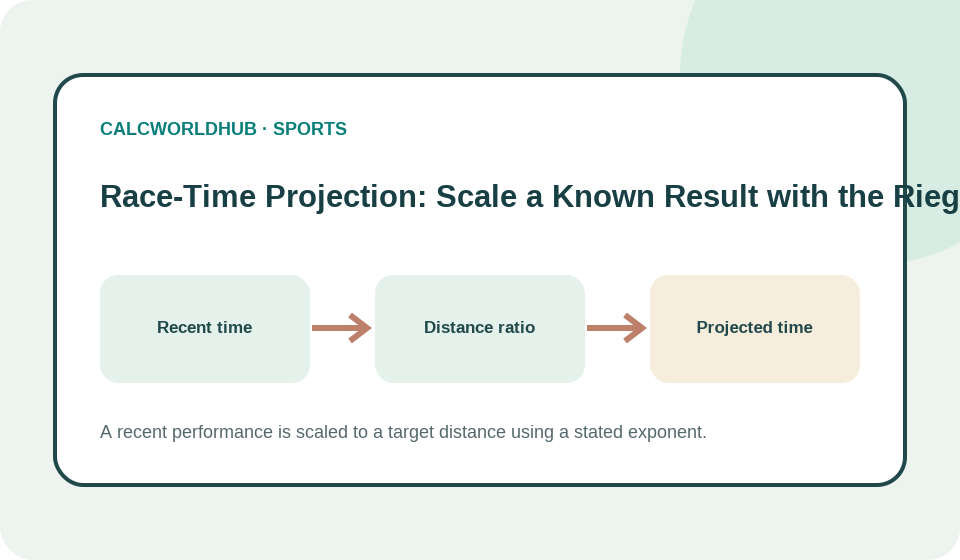

What the Riegel model projects
The Riegel model expresses race time as a power relationship with distance. It scales one recorded time by the ratio of target distance to recent distance raised to an exponent. In this calculator, the exponent is an input, with 1.06 as the displayed default; it is not a personal physiological measurement.
Longer target distances usually produce a time more than directly proportional to distance under an exponent above one. The model captures that assumption in one number, but a single prior result cannot represent every athlete's endurance, training, course, weather, pacing, or recovery. Keep the model's scope visible when sharing a projection.
Enter time, distances, and exponent
Enter the recent race time in minutes, the distance of that result in kilometres, and the target distance in kilometres. Use distances in the same unit so their ratio is dimensionless. A measured 10 km and a 21.0975 km half-marathon can be compared because both are entered as kilometres.
The exponent controls how quickly predicted time rises as the distance ratio grows. The default of 1.06 is often associated with the Riegel rule of thumb, but users can enter another value. Do not choose an exponent just to force a desired result; record why a different value is appropriate for the event or athlete.
Apply the distance-scaling equation
The equation is target time = recent time × (target distance ÷ recent distance)^exponent. Divide the target distance by the recent distance, raise that ratio to the entered exponent, and multiply by the recent time. Since the distances use matching units, the exponent applies to a pure ratio and the output retains minutes.
The calculator displays a decimal-minute projection. Multiply the fractional minute by 60 to express seconds if needed. That conversion changes only how the time is written; it does not add certainty to the projection or guarantee a race-day result.
Choose a relevant reference performance
Use a recent effort that reflects current fitness and a comparable event. A short all-out result can be a poor basis for a much longer target if the runner has not built endurance for it. Surface, elevation, heat, wind, turns, course certification, and time between events may all affect the starting time or target.
Peer-reviewed analysis of recreational runners found that the commonly used Riegel formula was better calibrated up to half-marathon distance than for marathon projections, where it substantially underestimated times for many runners in the sample. That study is a warning against treating one exponent as universally accurate, especially when projecting far beyond the reference distance.
Interpret the projection with its limits
Use a projection to set a broad expectation, compare race distances under stated assumptions, or start a planning conversation. It does not estimate a training plan, predict injury, account for missed training, or model heat and course elevation. A result from a flat road event should not be presented as a guarantee for a hilly or hot course.
Keep the inputs with the output: recent distance and time, target distance, exponent, and date of the reference effort. When the inputs change, the result changes. For a more personal estimate, compare several recent performances and consider event-specific coaching or validated performance models rather than relying on one calculation.
Worked examples
The two projections use the same exponent but different event distances and starting results.
Project a 5 km result to 10 km
Inputs: Recent time = 25 min; recent distance = 5 km; target distance = 10 km; exponent = 1.06.
Calculation: Target time = 25 × (10 ÷ 5)^1.06 = 52.12 min.
The model projects about 52.12 minutes, or approximately 52 min 7 sec.
Project a 10 km result to a half-marathon
Inputs: Recent time = 54 min; recent distance = 10 km; target distance = 21.0975 km; exponent = 1.06.
Calculation: Target time = 54 × (21.0975 ÷ 10)^1.06 = 119.15 min.
The projection is about 119.15 minutes, or approximately 1 hr 59 min 9 sec.
