
What a one-rep max estimate represents
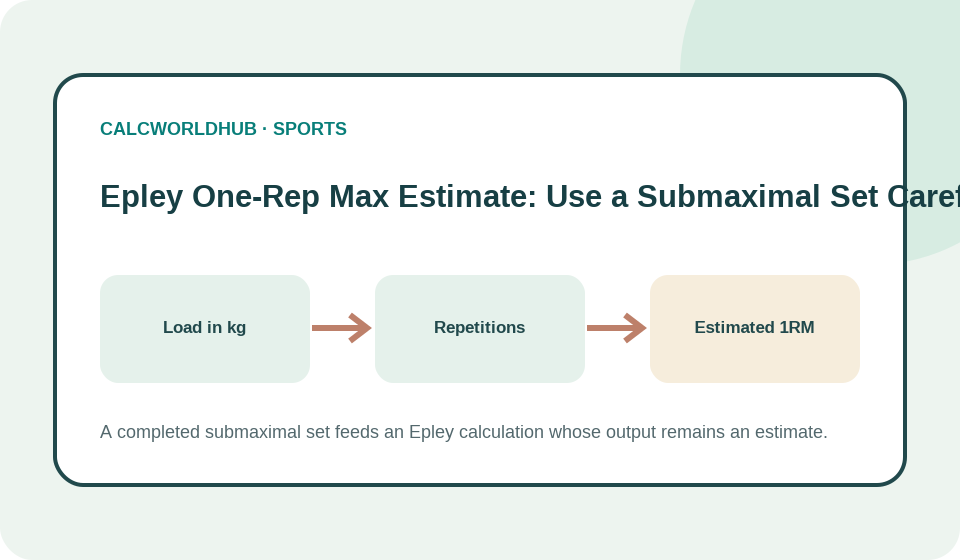
A one-repetition maximum, often shortened to 1RM, is the greatest load a person can complete once under a stated exercise technique and range of motion. Testing it directly is different from estimating it from a lighter set. The Epley equation gives a predicted value from the load and repetitions entered; it does not observe a single-repetition lift or confirm that the predicted load can be completed.
Prediction equations summarize a relationship between a set and a possible maximum. They cannot capture every difference in strength endurance, exercise skill, fatigue, equipment, or testing conditions. Treat the result as one estimate for the same lift, not as a universal measure of strength across exercises.
Read the load and repetition fields
Enter the external load used for one completed set in kilograms, then enter the number of repetitions completed. Use the load actually moved for the exercise and count complete repetitions performed with the technique and range of motion relevant to the estimate. A load in pounds should be converted to kilograms before using this kg-labelled calculator.
The calculator has no fields for exercise name, range of motion, repetitions in reserve, tempo, or whether a spotter assisted. Those details still matter when comparing results. Record them beside the number so a later estimate uses a comparable movement and set rather than a different exercise or a partial repetition.
How the Epley equation scales a set
The equation used here is estimated 1RM = load × (1 + repetitions ÷ 30). The repetition count is divided by 30, one is added to that fraction, and the multiplier is applied to the entered load. The calculation returns a load in kilograms because its only mass input is in kilograms.
The formula is linear in its repetition adjustment: each additional repetition increases the multiplier by the same amount. That simplicity makes it quick to apply, but it does not model changes in fatigue or lifting mechanics at higher repetition counts. Do not extend a simple equation into a claim that every set predicts a maximum equally well.
Choose a comparable set
The result depends on the set being a meaningful strength effort. A set stopped well before fatigue may not provide the same information as a hard completed set, while a set continued after technique changes can make the input count unreliable. The calculator cannot judge effort or form, so those judgments remain with the lifter and coach.
Research comparing prediction equations reports that estimates vary with the exercise and repetition range. One study summarized in a peer-reviewed review found more accurate prediction from a five-repetition set than from ten- or twenty-repetition sets for the tested machine exercises. That evidence is not a universal rep limit; it is a reason to keep the set context visible and avoid false precision.
Use the estimate as a reference, not a guarantee
Two athletes can complete the same load for the same repetitions and still have different tested maxima. A result rounded to two decimal places is a display choice, not evidence that the underlying prediction is accurate to a hundredth of a kilogram. Use rounded values for notes, and keep the original load and repetition count if you want to compare later estimates.
An estimated maximum can help organize a training discussion or compare repeated estimates under similar conditions. It does not select an appropriate training load, prescribe a program, diagnose an injury, or replace qualified coaching. Stop if pain or unsafe technique occurs, and do not attempt a heavy single solely because a calculator displays that value.
Worked examples
Both examples use completed sets and retain the same kilogram basis from input through result.
A five-repetition set at 80 kg
Inputs: Load = 80 kg; completed repetitions = 5.
Calculation: Estimated 1RM = 80 kg × (1 + 5 ÷ 30) = 93.33 kg.
The Epley estimate is about 93.33 kg; it is not a tested single.
An eight-repetition set at 60 kg
Inputs: Load = 60 kg; completed repetitions = 8.
Calculation: Estimated 1RM = 60 kg × (1 + 8 ÷ 30) = 76.00 kg.
The estimate is 76.00 kg, subject to the set and exercise assumptions above.
