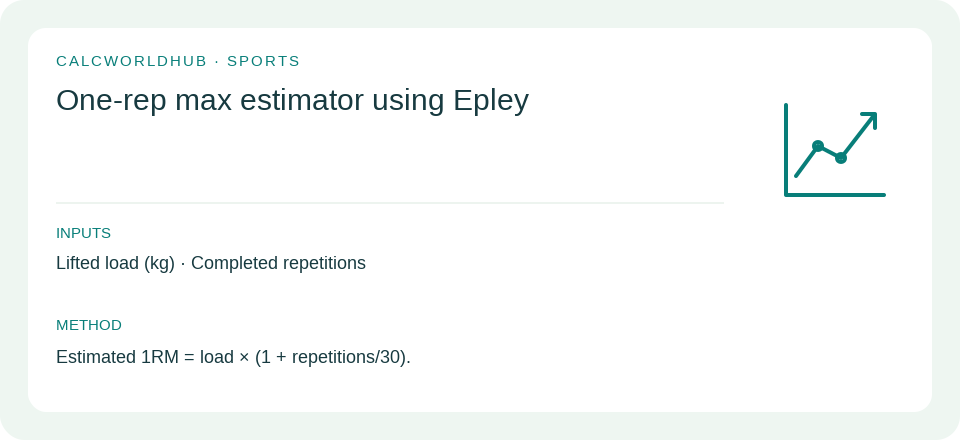
One-rep max estimator using Epley
Use a completed set and the load lifted. The output is a prediction from an empirical equation, not a tested maximum.
Calculator
How to use this calculator
Estimate a one-repetition maximum from a completed lift using the Epley equation.
- Enter Lifted load (kg), Completed repetitions. Match the units shown beside each field and review the result together with the assumptions below.
- Read the worked example below to check the expected input format and result.
- Compare another scenario by changing one input at a time. Use Reset to return to the starting values.
One-rep max estimator using Epley
Use a completed set and the load lifted. The output is a prediction from an empirical equation, not a tested maximum.
What it measures
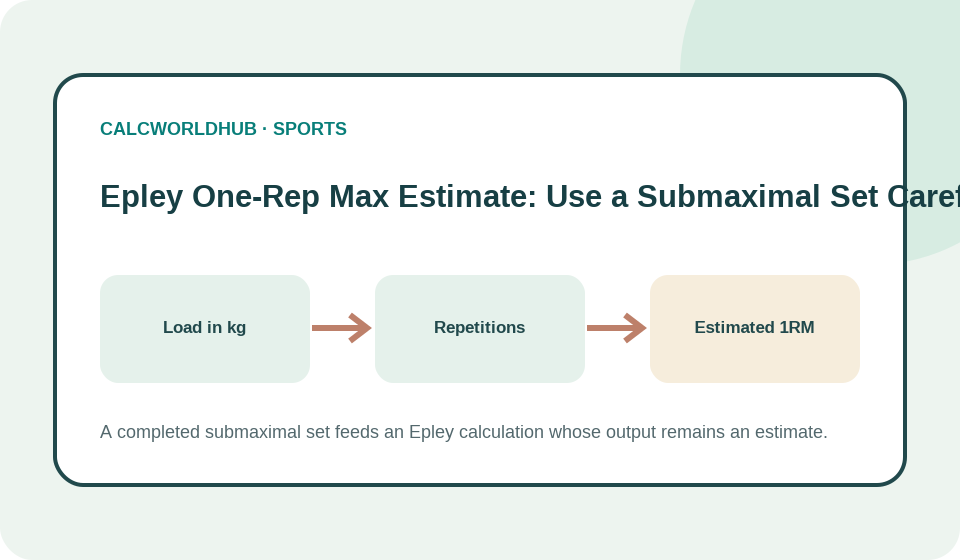
The Epley equation extrapolates from a multi-repetition load to an estimated single-repetition maximum.
Inputs and units
- Lifted load (kg): Load completed for the set, in kilograms.
- Completed repetitions: Positive whole-number repetitions completed with that load.
Formula and method
Estimated 1RM = load × (1 + repetitions/30).
Worked example
An 80 kg lift for 5 repetitions gives 80×(1+5/30) = 93.33 kg estimated 1RM.
Interpreting the result
Treat the result as a comparison estimate. It can inform rough planning, but it is not the same as safely testing a true single repetition.
Assumptions and limits
Prediction accuracy varies with exercise, training status, effort, technique, and repetition count; equations tend to be less dependable for high-repetition sets. Use appropriate supervision and avoid lifting beyond your capability.
Sources and method
- Compares Epley and other equations and illustrates that predicted one-repetition maxima are model-based estimates whose accuracy depends on exercise and repetition range. Peer-reviewed comparison of repetition-based 1RM prediction equations
Frequently asked questions
Is the estimate a measured maximum?
No. It is an equation-based estimate from a submaximal set.
Does the equation work equally well at every repetition count?
No. Prediction error depends on exercise and repetition range; use low-repetition inputs cautiously.
How do I use the One-rep max estimator using Epley?
Enter Lifted load (kg), Completed repetitions. Match the units shown beside each field and review the result together with the assumptions below.
What is a worked example of One-rep max estimator using Epley?
An 80 kg lift for 5 repetitions gives 80×(1+5/30) = 93.33 kg estimated 1RM.
What does the One-rep max estimator using Epley calculate?
Estimate a one-repetition maximum from a completed lift using the Epley equation.
See the calculation methodology.
Good calculators show their work.
CalcWorldHub is built around clear inputs and visible assumptions. Results are estimates for planning; check official sources or your provider’s terms when exact figures matter.