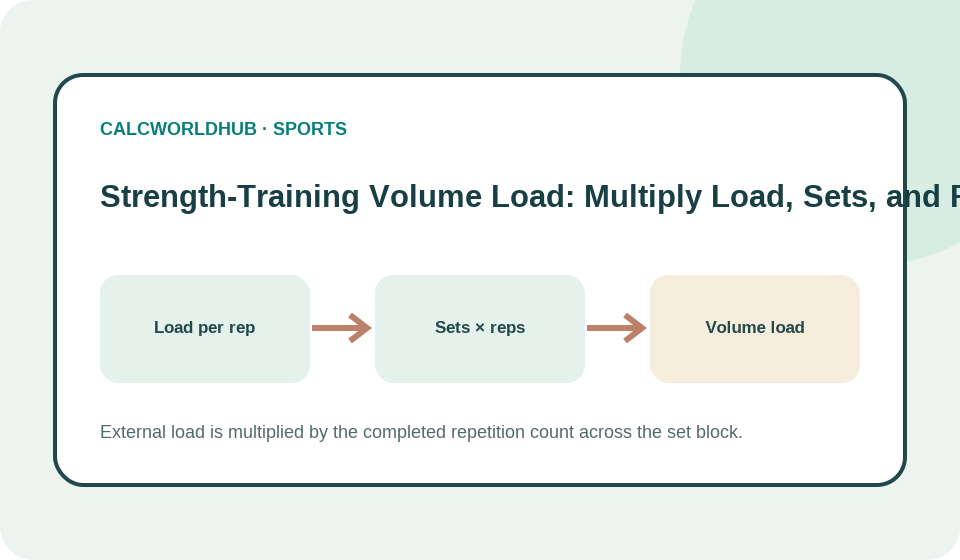

Define the volume-load total
Volume load is commonly calculated as load multiplied by sets and repetitions. The result may be written as kilogram-repetitions when the load is in kilograms. It is a bookkeeping total for external weight lifted across the set entries, not the mass of a single object or a direct measurement of muscle growth.
Researchers have used sets × repetitions × load to monitor resistance-training volume. The measure is useful because it is transparent and easy to compare when the exercise and load conventions stay the same. It does not by itself describe effort, fatigue, movement speed, range of motion, or how challenging the final repetitions felt.
Read the three inputs
Load per repetition is entered in kilograms. Sets and repetitions per set are whole counts in this calculator. Use the load that corresponds to one repetition of the chosen exercise and enter completed work, not a planned set that was skipped or cut short.
If the sets had different loads or repetition counts, multiplying one load by one set count and one rep count will not represent all the work. Calculate each distinct block separately and add the totals, or use a method that accepts per-set entries. Include the same exercise and equipment convention when comparing sessions.
Multiply load by total repetitions
The equation is volume load = load × sets × repetitions per set. Multiply the set count by repetitions per set to get the total repetition count, then multiply by the entered load. Kilograms remain in the result alongside the repetition count, often written kg·reps.
For a unilateral exercise, decide whether one repetition means one side or a completed pair of sides and use the same convention each time. The calculator does not ask for limb, exercise, machine, or range of motion. If you change the recording convention, a change in the number may reflect bookkeeping rather than a change in training.
Compare only like-for-like sessions
Volume load can support a log of repeated sessions, but a larger total is not automatically a better workout. More repetitions, heavier load, or more sets each increase the arithmetic total; they can also change the intended session. A comparison should identify which variables changed and whether the exercise remained comparable.
Volume-load totals can differ even when two workouts feel similarly demanding. A lighter load for many repetitions may equal a heavier load for fewer repetitions, while the stimulus and fatigue are not necessarily interchangeable. Research on training volume also distinguishes other dimensions such as time under tension, reinforcing that one arithmetic total cannot describe every training property.
Use volume load as one training measure
Record load, sets, repetitions, and exercise together. If you are tracking several exercises, do not combine them into one number without labeling the movement mix; a row and a squat can produce the same total but involve different muscles and tasks. Keep training records consistent rather than chasing a single target total.
This calculator estimates only the multiplication of the three inputs. It does not evaluate recovery, prescribe a routine, determine a safe load, or assess injury risk. If you need a personalized program or have a health concern, seek qualified guidance. Use the value as a transparent log entry and interpret it beside effort and movement quality.
Worked examples
The calculations multiply the same load by every completed repetition in the entered sets.
Three sets of eight at 60 kg
Inputs: Load = 60 kg; sets = 3; repetitions per set = 8.
Calculation: Volume load = 60 kg × 3 sets × 8 reps = 1,440 kg·reps.
The entered exercise totals 24 repetitions at 60 kg, or 1,440 kg·reps.
Four sets of six at 42.5 kg
Inputs: Load = 42.5 kg; sets = 4; repetitions per set = 6.
Calculation: Volume load = 42.5 kg × 4 sets × 6 reps = 1,020 kg·reps.
The total is 24 repetitions at the entered load, or 1,020 kg·reps.
