
What field-goal percentage counts
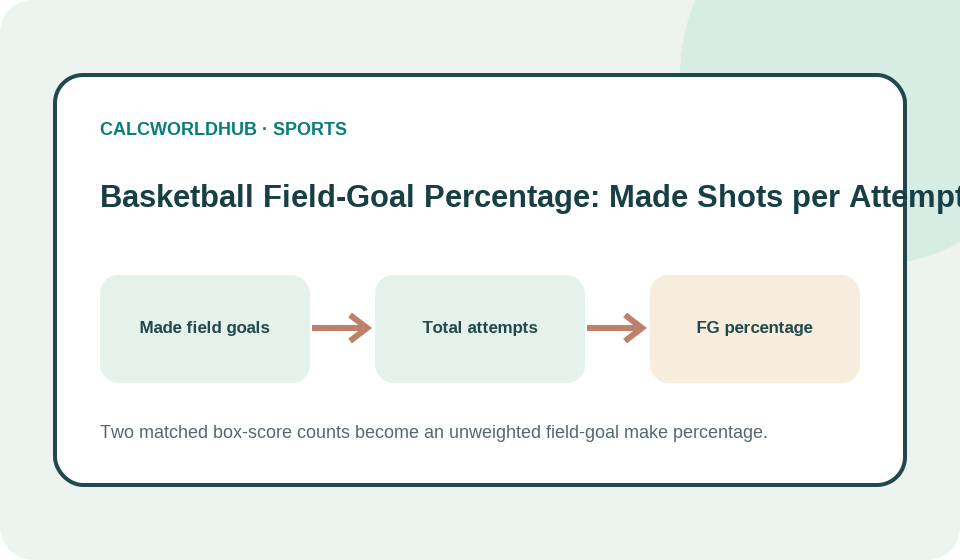
Field-goal percentage, or FG%, is made field goals divided by field-goal attempts, multiplied by 100. The numerator is the number of shots made from the field and the denominator is the number of attempts from the field. It is a rate of made shots, not points per attempt or a measure of all scoring.
The NBA glossary expresses FG% as field goals made divided by field goals attempted. A made two-pointer and a made three-pointer each count as one made field goal in this basic ratio. Free throws are tracked separately, so do not mix free-throw makes or attempts into these two inputs.
Enter matching made and attempt counts
Use counts from the same player or team, time period, and game sample. If you enter season makes with one game's attempts, the result has no coherent denominator. A box score commonly reports FGM and FGA; make sure the selected columns refer to the same competition and scope.
In a clean statistical record, made shots cannot exceed attempts, and attempts should be positive before a percentage is calculated. The calculator has only two count fields; it does not identify a player, separate shot locations, or verify the box score. Confirm the source totals before interpreting the output.
Apply the percentage formula
FG% = field goals made ÷ field goals attempted × 100. Dividing first produces the fraction of attempts that became field goals, and multiplying by 100 converts that fraction to a percentage. If the fraction is 0.60, the reported rate is 60%.
The denominator is essential. When makes and attempts grow in the same proportion, the percentage can remain unchanged even though the sample size differs. A matching rate does not mean two samples have identical statistical uncertainty or performance context.
Separate accuracy from shot value
Because ordinary FG% counts made twos and threes alike, it does not weight a three-pointer by its extra point. The NBA glossary distinguishes effective field-goal percentage, which adjusts for made three-pointers. If the question is how much scoring value came from the shots, use an appropriate points-aware statistic rather than reading FG% as points efficiency.
FG% also does not include free throws, assists, shot difficulty, game state, or possessions. Compare like with like: position, role, shot mix, opponent, and time on court may explain differences that the percentage alone cannot. Do not infer skill from one small sample.
Interpret the percentage in its scoring context
A displayed percentage is a rounded summary of the entered counts. For example, 7 makes from 12 attempts is 58.333...%, which may be displayed to a limited number of decimal places. Keep the counts when precision matters; a rounded rate cannot be reliably converted back into the original counts.
Use the result for a quick check or a consistent table, not as a full player evaluation. For teams or multiple games, aggregate makes and attempts first, then divide the totals. Averaging individual game percentages without weighting by attempts can produce a different number from the overall made-shots rate.
Worked examples
Each example uses made field goals as the numerator and all field-goal attempts in the same sample as the denominator.
Nine makes in fifteen attempts
Inputs: Made field goals = 9; field-goal attempts = 15.
Calculation: FG% = 9 ÷ 15 × 100 = 60%.
The player made 60% of the field-goal attempts in this sample.
Fourteen makes in twenty-five attempts
Inputs: Made field goals = 14; field-goal attempts = 25.
Calculation: FG% = 14 ÷ 25 × 100 = 56%.
The made-shot share is 56%; this does not weight a three-pointer more than a two-pointer.

Read a rate with its sample size
A percentage is easier to compare when the sample size stays visible. The ratio can remain identical as both made shots and attempts grow, but a longer sample usually gives a more stable descriptive summary than a short stretch. That does not prove future shooting will match the same percentage; it only makes the past sample larger.
When combining games, sum the made field goals and sum the attempts, then calculate the rate from those totals. Do not take a simple average of game percentages unless every game has the same number of attempts. Weighting by attempts is what makes the overall percentage describe the fraction of all recorded shots that went in.