Strength training volume calculator
Use the same exercise and load unit across the session. Volume load is a bookkeeping total, not a complete measure of training stimulus.
Calculator
How to use this calculator
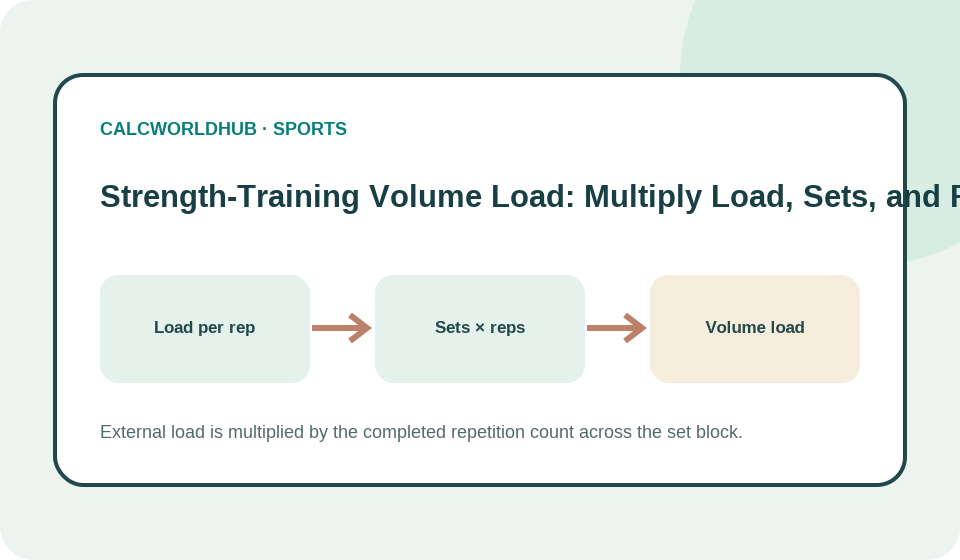
Calculate volume load as load per repetition multiplied by completed sets and repetitions.
- Enter Load per repetition (kg), Completed sets, Repetitions per set. Match the units shown beside each field and review the result together with the assumptions below.
- Read the worked example below to check the expected input format and result.
- Compare another scenario by changing one input at a time. Use Reset to return to the starting values.
Strength training volume calculator
Use the same exercise and load unit across the session. Volume load is a bookkeeping total, not a complete measure of training stimulus.
What it measures
The calculation sums repeated load exposure by multiplying the entered load by sets and repetitions per set.
Inputs and units
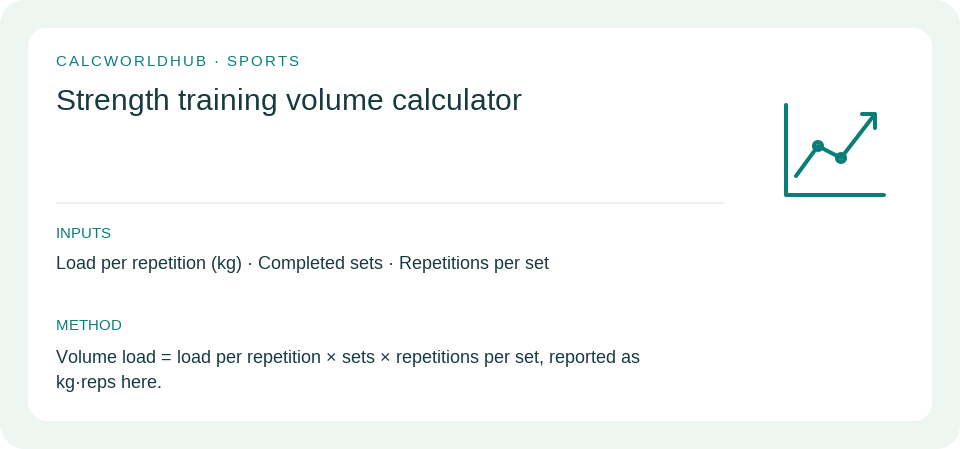
- Load per repetition (kg): Load moved for one repetition, in kilograms.
- Completed sets: Completed set count; use a whole number.
- Repetitions per set: Completed repetitions per set; use a whole number.
Formula and method
Volume load = load per repetition × sets × repetitions per set, reported as kg·reps here.
Worked example
A 60 kg load for 3 sets of 8 repetitions gives 60×3×8 = 1,440 kg·reps.
Interpreting the result
This total allows rough comparison of sessions only when exercise, range of motion, effort, and counting rules are similar.
Assumptions and limits
The measure does not include intensity relative to maximum, proximity to failure, technique, tempo, rest, range of motion, or exercise difficulty. Zero sets or repetitions correctly yields zero volume.
Frequently asked questions
Does higher volume load always mean a better workout?
No. It omits effort, movement quality, exercise selection, and recovery.
Can I compare two different exercises directly?
Only cautiously; the same load total may represent very different work and difficulty.
How do I use the Strength training volume calculator?
Enter Load per repetition (kg), Completed sets, Repetitions per set. Match the units shown beside each field and review the result together with the assumptions below.
What is a worked example of Strength training volume?
A 60 kg load for 3 sets of 8 repetitions gives 60×3×8 = 1,440 kg·reps.
What does the Strength training volume calculator calculate?
Calculate volume load as load per repetition multiplied by completed sets and repetitions.
See the calculation methodology.
Good calculators show their work.
CalcWorldHub is built around clear inputs and visible assumptions. Results are estimates for planning; check official sources or your provider’s terms when exact figures matter.