How to use this calculator
Size a current-sense shunt from maximum current and allowed voltage drop.
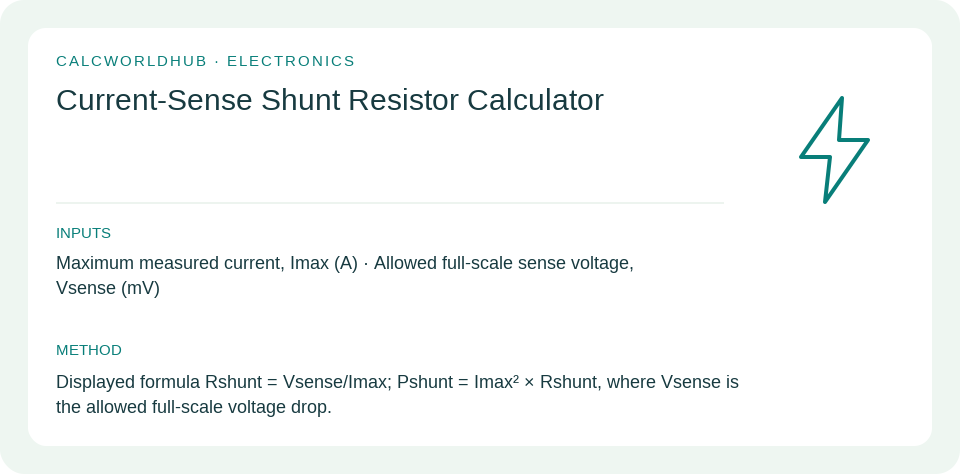
- Enter Maximum measured current, Imax (A), Allowed full-scale sense voltage, Vsense (mV). Match the units shown beside each field and review the result together with the assumptions below.
- Read the worked example below to check the expected input format and result.
- Compare another scenario by changing one input at a time. Use Reset to return to the starting values.
How this calculation works
Enter maximum current and the allowed voltage drop across the shunt at that current. Enter current in amperes and sense voltage in millivolts.
Inputs and units
maxCurrent— Maximum measured current, Imax (A)- Full-scale current that flows through the shunt.
senseVoltageMv— Allowed full-scale sense voltage, Vsense (mV)- Maximum voltage drop across the shunt at Imax.
Formula
Rshunt = Vsense/Imax; Pshunt = Imax² × Rshunt, where Vsense is the allowed full-scale voltage drop.
Method
Convert millivolts to volts, divide by maximum current to find resistance, then calculate ideal shunt dissipation at full-scale current. Select a real component using its power, temperature, tolerance, pulse, and thermal conditions.
Worked example
At 10 A with a 75 mV full-scale sense limit, Rshunt = 0.075/10 = 0.0075 Ω and ideal full-scale dissipation is 0.75 W.
Assumptions and limits
This estimates ideal steady-state resistance and dissipation. It does not select a safe component rating or account for temperature rise, self-heating drift, parasitic inductance, amplifier offset, transient current, layout, or measurement uncertainty.
Frequently asked questions
Why does lower sense voltage make a smaller signal?
At fixed current, lower Vsense means lower shunt resistance and proportionally less voltage for the sensing circuit.
Does calculated wattage select a resistor rating?
No. Check component derating and thermal behavior under expected operating conditions; this is ideal dissipation only.
Should I include transient current?
Use the actual peak current for the design scenario and separately evaluate pulses, faults, and front-end limits.
How do I use the Current-Sense Shunt Resistor Calculator?
Enter Maximum measured current, Imax (A), Allowed full-scale sense voltage, Vsense (mV). Match the units shown beside each field and review the result together with the assumptions below.
What is a worked example of Current-Sense Shunt Resistor?
At 10 A with a 75 mV full-scale sense limit, Rshunt = 0.075/10 = 0.0075 Ω and ideal full-scale dissipation is 0.75 W.
Read our calculation methodology.