How to use this calculator
Measure how a symmetric static actuator dead zone weakens the fundamental of a sinusoidal command.
- Enter Sinusoidal input amplitude, Dead-zone half width, Outside slope. Match the units shown beside each field and review the result together with the assumptions below.
- Read the worked example below to check the expected input format and result.
- Compare another scenario by changing one input at a time. Use Reset to return to the starting values.
Dead zone fundamental describing function explained
Calculate the first-harmonic describing function for a symmetric dead-zone element driven by a sinusoid.
A numerical walkthrough
Sinusoidal input amplitude = 2; Dead-zone half width = 0.5; Outside slope = 1.5.
- Fundamental equivalent gain: 1.027556 output/input
- Fundamental output amplitude: 2.055113 output units
A two-unit sine crosses a half-unit dead zone before a slope of 1.5 becomes active.
The model behind the numbers
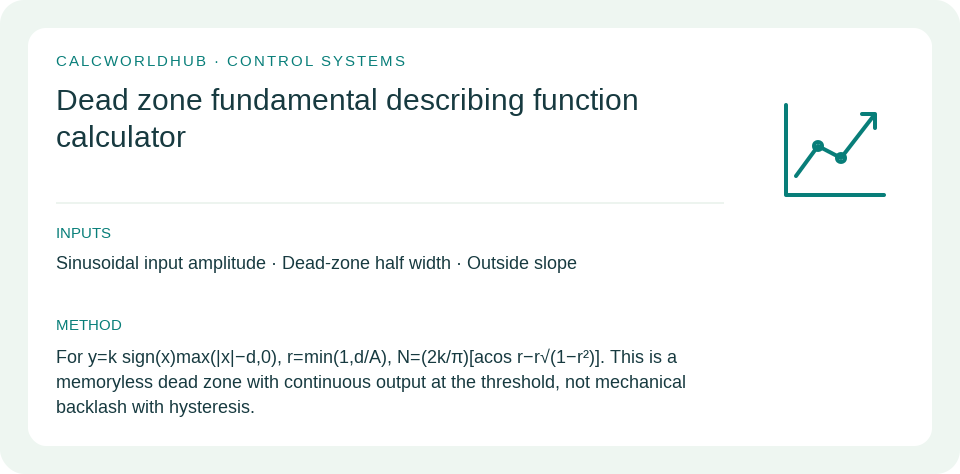
For y=k sign(x)max(|x|−d,0), r=min(1,d/A), N=(2k/π)[acos r−r√(1−r²)].
This is a memoryless dead zone with continuous output at the threshold, not mechanical backlash with hysteresis.
What to enter
A— Sinusoidal input amplitude- Positive peak input amplitude.
d— Dead-zone half width- Input magnitude below which output remains zero.
k— Outside slope- Positive slope after the dead zone.
Interpreting the result
No backlash memory, stiction or asymmetric thresholds.
Reading the outputs
Gain and output amplitude describe only the fundamental component; a command inside the dead zone produces zero.
Frequently asked questions
Is dead zone the same as hysteresis?
No. This model depends only on the present input.
What if amplitude is below the threshold?
The complete output is zero.
Can a negative width be entered?
No; the half width is nonnegative.
How do I use the Dead zone fundamental describing function calculator?
Enter Sinusoidal input amplitude, Dead-zone half width, Outside slope. Match the units shown beside each field and review the result together with the assumptions below.
What is a worked example of Dead zone fundamental describing function?
Sinusoidal input amplitude = 2; Dead-zone half width = 0.5; Outside slope = 1.5. Fundamental equivalent gain: 1.027556 output/input Fundamental output amplitude: 2.055113 output units A two-unit sine crosses a half-unit dead zone before a slope of 1.5 becomes active.
Read our calculation methodology.