How to use this calculator
Estimate the first-harmonic gain of a symmetric saturating actuator driven by a sine wave.
- Enter Sinusoidal input amplitude, Symmetric output limit, Unsaturated slope. Match the units shown beside each field and review the result together with the assumptions below.
- Read the worked example below to check the expected input format and result.
- Compare another scenario by changing one input at a time. Use Reset to return to the starting values.
Saturation fundamental describing function explained
Calculate the fundamental gain of a clipped sine using the symmetric saturation describing function.
How the calculation works
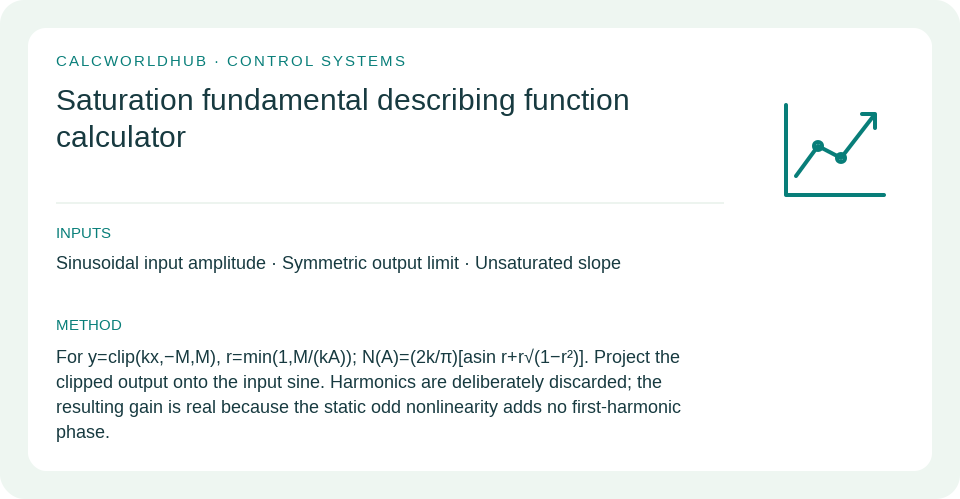
For y=clip(kx,−M,M), r=min(1,M/(kA)); N(A)=(2k/π)[asin r+r√(1−r²)].
Project the clipped output onto the input sine. Harmonics are deliberately discarded; the resulting gain is real because the static odd nonlinearity adds no first-harmonic phase.
Set up the calculation
A— Sinusoidal input amplitude- Positive peak amplitude entering the static nonlinearity.
M— Symmetric output limit- Positive saturation level.
k— Unsaturated slope- Positive small-signal output/input slope.
Limits of this model
Describing-function analysis is approximate and does not by itself establish a nonlinear limit cycle.
Check this example
Sinusoidal input amplitude = 3; Symmetric output limit = 1; Unsaturated slope = 2.
- Fundamental equivalent gain: 0.42244 output/input
- Fundamental output amplitude: 1.26732 output units
- Input fraction at clipping threshold: 0.166667 ratio
A three-unit sine enters slope two and output limits ±1; its fundamental gain is much lower than its small-signal slope.
For the supplied clipped sine, the equivalent fundamental gain is about 0.42244 and the fundamental output amplitude about 1.26732 units.
Reading the outputs
Equivalent gain multiplies the input peak amplitude; threshold fraction describes how deeply the waveform clips.
Frequently asked questions
Why is the gain amplitude dependent?
Larger inputs spend more of each cycle at the output limits.
Does this predict harmonic distortion?
Only the fundamental amplitude is returned, not every harmonic.
What happens without clipping?
The equivalent gain equals the unsaturated slope.
How do I use the Saturation fundamental describing function calculator?
Enter Sinusoidal input amplitude, Symmetric output limit, Unsaturated slope. Match the units shown beside each field and review the result together with the assumptions below.
What is a worked example of Saturation fundamental describing function?
Sinusoidal input amplitude = 3; Symmetric output limit = 1; Unsaturated slope = 2. Fundamental equivalent gain: 0.42244 output/input Fundamental output amplitude: 1.26732 output units Input fraction at clipping threshold: 0.166667 ratio A three-unit sine enters slope two and output limits ±1; its fundamental gain is much lower than its small-signal slope. For the supplied clipped sine, the equivalent fundamental gain is about 0.42244 and the fundamental output amplitude about 1.26732 units.
Read our calculation methodology.