How to use this calculator
Estimate the electrostatic screening length of an electrolyte from ionic strength, temperature, and permittivity.
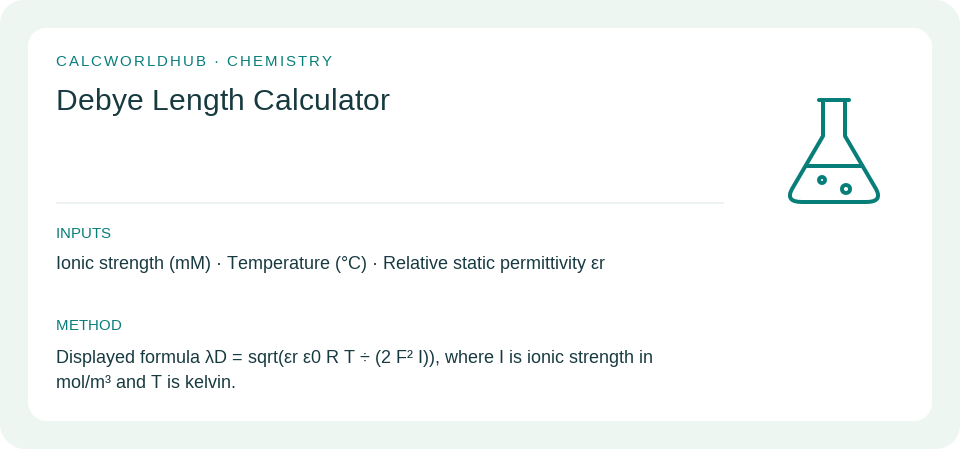
- Enter Ionic strength (mM), Temperature (°C), Relative static permittivity εr. Match the units shown beside each field and review the result together with the assumptions below.
- Read the worked example below to check the expected input format and result.
- Compare another scenario by changing one input at a time. Use Reset to return to the starting values.
How this calculation works
The Debye length is the characteristic distance over which an electrostatic potential decays in an electrolyte. In the dilute-solution approximation it depends on the solvent permittivity, absolute temperature, and ionic strength.
Inputs and units
ionicStrengthMm— Ionic strength (mM)- Electrolyte ionic strength in millimoles per liter.
temperatureC— Temperature (°C)- Solution temperature in degrees Celsius.
relativePermittivity— Relative static permittivity εr- Dimensionless relative permittivity of the solvent at the entered conditions.
Formula
λD = sqrt(εr ε0 R T ÷ (2 F² I)), where I is ionic strength in mol/m³ and T is kelvin.
Method
Enter ionic strength in millimolar (mM), solution temperature in °C, and relative static permittivity. One mM equals one mol/m³. The calculator uses the dilute electrolyte screening-length equation and reports nanometers.
Worked example
For water at 25 °C with relative permittivity 78.3 and ionic strength 1.0 mM, the estimated Debye length is about 9.61 nm.
Assumptions and limits
This Debye-Hückel screening estimate assumes a continuum solvent and dilute electrolyte behavior. At high concentrations, ion correlations, specific interactions, solvent structure, and concentration-dependent permittivity can make the simple Debye length inaccurate; it is not a particle size or a direct measurement of interaction range in every system.
Frequently asked questions
What does Debye length represent?
It is a characteristic scale for electrostatic potential screening in an electrolyte.
Why does higher ionic strength shorten the length?
More dissolved charge carriers screen electrostatic fields over a shorter distance in the dilute model.
Is this accurate for concentrated solutions?
The simple Debye-Hückel approximation can be inaccurate when concentrations or specific interactions are large.
How do I use the Debye Length Calculator?
Enter Ionic strength (mM), Temperature (°C), Relative static permittivity εr. Match the units shown beside each field and review the result together with the assumptions below.
What is a worked example of Debye Length?
For water at 25 °C with relative permittivity 78.3 and ionic strength 1.0 mM, the estimated Debye length is about 9.61 nm.
Reference: IUPAC Gold Book definition and equation for electrolyte double-layer thickness (Debye length). See our calculation methodology.