How to use this calculator
Express the observed number of defective units as parts per million units inspected.
- Enter Defective units observed, Total units inspected. Match the units shown beside each field and review the result together with the assumptions below.
- Read the worked example below to check the expected input format and result.
- Compare another scenario by changing one input at a time. Use Reset to return to the starting values.
How this calculation works
Defective parts per million (DPPM) is a unit-based rate: the numerator counts defective units and the denominator counts units inspected. It differs from defects per million opportunities (DPMO), whose denominator counts possible defect opportunities within those units.
Inputs and units
defective— Defective units observed- Count units that fail the acceptance definition; count each unit once.
inspected— Total units inspected- Include all units in the inspected sample or lot represented by the numerator.
Formula
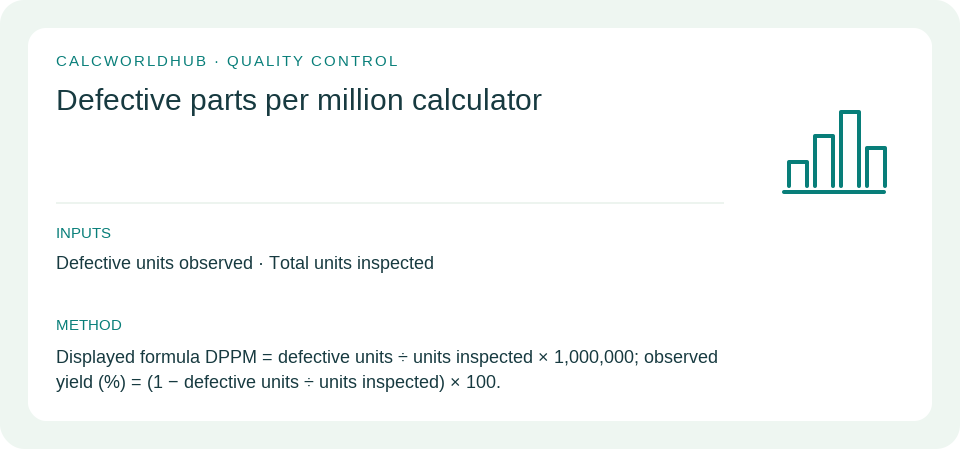
DPPM = defective units ÷ units inspected × 1,000,000; observed yield (%) = (1 − defective units ÷ units inspected) × 100.
Method
Count each defective unit once in the numerator, even if it has multiple defects, and enter the total number of units inspected as the denominator.
Worked example
Seven defective units among 10,000 inspected give 7 ÷ 10,000 × 1,000,000 = 700 DPPM and an observed unit yield of 99.93%.
Assumptions and limits
This observed rate is not a confidence interval or a guarantee of future quality. Sampling method, inspection sensitivity, and the definition of a defective unit affect the result.
Frequently asked questions
How is DPPM different from DPMO?
DPPM counts defective units per million units. DPMO counts defects relative to the number of possible defect opportunities, so one unit can contribute several opportunities.
Should a unit with three defects count three times?
For DPPM, count it once as one defective unit. A defect-count metric uses a different numerator.
Does a sample result predict the exact next-lot rate?
No. It describes the observed sample. Future production can differ, and sampling uncertainty is not calculated here.
How do I use the Defective parts per million calculator?
Enter Defective units observed, Total units inspected. Match the units shown beside each field and review the result together with the assumptions below.
What is a worked example of Defective parts per million?
Seven defective units among 10,000 inspected give 7 ÷ 10,000 × 1,000,000 = 700 DPPM and an observed unit yield of 99.93%.
Read our calculation methodology.