How to use this calculator
Calculate rings-plus-pi-bond equivalents from a neutral organic molecular formula’s C, H, N, and halogen atom counts.
- Enter Carbon atoms (C), Hydrogen atoms (H), Nitrogen atoms (N), Halogen atoms (F + Cl + Br + I). Match the units shown beside each field and review the result together with the assumptions below.
- Read the worked example below to check the expected input format and result.
- Compare another scenario by changing one input at a time. Use Reset to return to the starting values.
How this calculation works
The degree of unsaturation, also called double-bond equivalent or index of hydrogen deficiency, compares the hydrogen count with a saturated reference formula. The result counts the total number of rings and pi-bond equivalents; it cannot tell which structural arrangement a molecule has.
Inputs and units
carbonAtoms— Carbon atoms (C)- Number of carbon atoms in the molecular formula.
hydrogenAtoms— Hydrogen atoms (H)- Number of hydrogen atoms in the molecular formula.
nitrogenAtoms— Nitrogen atoms (N)- Number of nitrogen atoms in the molecular formula.
halogenAtoms— Halogen atoms (F + Cl + Br + I)- Add all monovalent halogen atoms in the formula.
Formula
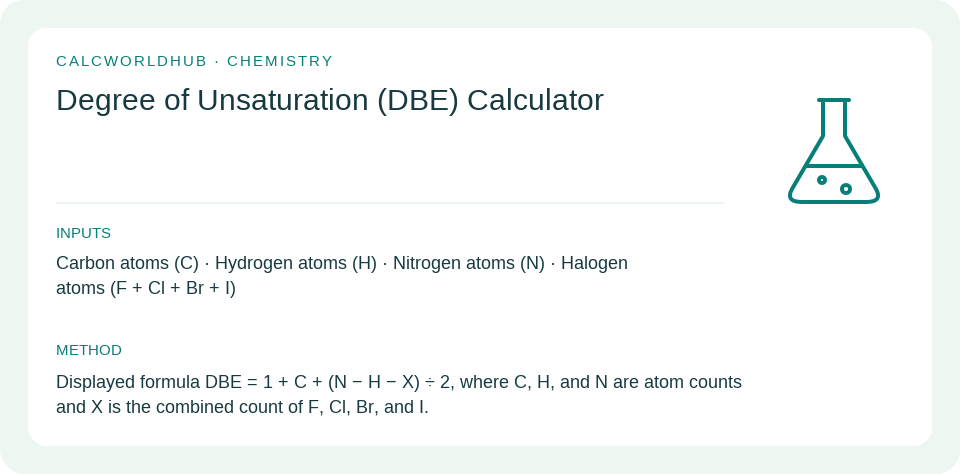
DBE = 1 + C + (N − H − X) ÷ 2, where C, H, and N are atom counts and X is the combined count of F, Cl, Br, and I.
Method
Enter nonnegative whole-number counts for carbon, hydrogen, nitrogen, and all halogen atoms in one neutral molecular formula. Oxygen and other ordinary divalent atoms do not change this index under the stated CHNX model.
Worked example
For C₆H₁₀O, use C = 6, H = 10, N = 0, and X = 0. DBE = 1 + 6 + (0 − 10 − 0)/2 = 2, consistent with two total ring/π-bond equivalents.
Assumptions and limits
This shortcut assumes a neutral, conventional-valence formula made from carbon, hydrogen, nitrogen, and monovalent halogens, optionally with oxygen or sulfur. It is a screening index, not a structure solver. A fractional or negative value signals that the entered formula does not fit the ordinary neutral closed-shell interpretation; the arithmetic does not validate chemical feasibility. Ions, radicals, metals and unusual valence states need separate treatment.
Frequently asked questions
Does oxygen change the DBE result?
No. Oxygen is omitted from the standard CHNX degree-of-unsaturation formula because a divalent oxygen does not change the saturated hydrogen count.
Does a DBE of 2 mean two double bonds?
Not necessarily. It could represent two rings, two double bonds, one ring plus one double bond, or one triple bond.
Should I count chlorine and bromine as hydrogen?
Count every F, Cl, Br, or I atom in the halogen field; the formula treats each monovalent halogen like a hydrogen for this calculation.
Can I use this for an ion or radical?
This page assumes a neutral conventional-valence molecular formula. Charged or unusual-valence species need charge- and valence-aware interpretation.
How do I use the Degree of Unsaturation (DBE) Calculator?
Enter Carbon atoms (C), Hydrogen atoms (H), Nitrogen atoms (N), Halogen atoms (F + Cl + Br + I). Match the units shown beside each field and review the result together with the assumptions below.
Reference: OpenStax Organic Chemistry degree-of-unsaturation formula. See our calculation methodology.