How to use this calculator
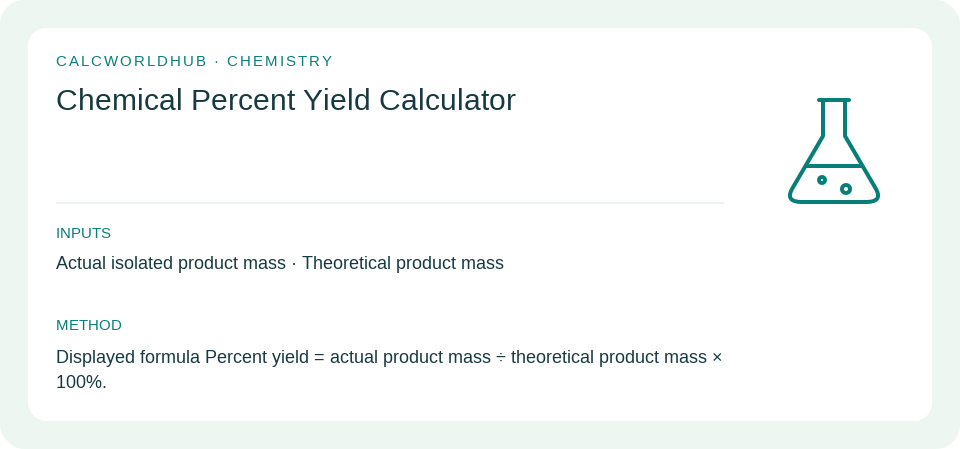
Compare an isolated product mass with its calculated theoretical yield.
- Enter Actual isolated product mass, Theoretical product mass. Match the units shown beside each field and review the result together with the assumptions below.
- Read the worked example below to check the expected input format and result.
- Compare another scenario by changing one input at a time. Use Reset to return to the starting values.
How this calculation works
Percent yield evaluates a reaction run by comparing the amount of product actually recovered with the theoretical amount predicted from stoichiometry. It is an experimental outcome measure, whereas theoretical yield alone does not include the product mass recovered from the lab or process.
Inputs and units
actual— Actual isolated product mass- Mass of product recovered after the experiment or process, in grams.
theoretical— Theoretical product mass- Maximum product mass calculated from the balanced reaction and limiting reactant, in grams.
Formula
Percent yield = actual product mass ÷ theoretical product mass × 100%.
Method
The calculator divides the measured isolated product mass by the theoretical yield for the limiting-reagent calculation. Both masses must use the same unit and refer to the same desired product.
Worked example
If 8.4 g of product is isolated and the stoichiometric theoretical yield is 10.5 g, the percent yield is 8.4 ÷ 10.5 × 100 = 80%.
Assumptions and limits
A result above 100% can indicate residual solvent, impurities, measurement error, or a mismatched theoretical-yield basis. The estimate does not identify the cause or correct the product mass.
Frequently asked questions
How do I find the theoretical yield?
Use the balanced chemical equation and limiting reactant to calculate the maximum mass of the desired product.
Is percent yield the same as atom economy?
No. Percent yield describes an experiment's recovered amount; atom economy compares the theoretical mass incorporated into a desired product with reactant mass.
Can percent yield be over 100%?
Yes, mathematically. Check for moisture, solvent, impurities, measurement error, or mismatched units when it happens.
How do I use the Chemical Percent Yield Calculator?
Enter Actual isolated product mass, Theoretical product mass. Match the units shown beside each field and review the result together with the assumptions below.
What is a worked example of Chemical Percent Yield?
If 8.4 g of product is isolated and the stoichiometric theoretical yield is 10.5 g, the percent yield is 8.4 ÷ 10.5 × 100 = 80%.
Reference: OpenStax Chemistry and LibreTexts reaction-yield or atom-economy reference. See our calculation methodology.