How to use this calculator
Estimate what share of balanced-reactant mass appears in the desired product.
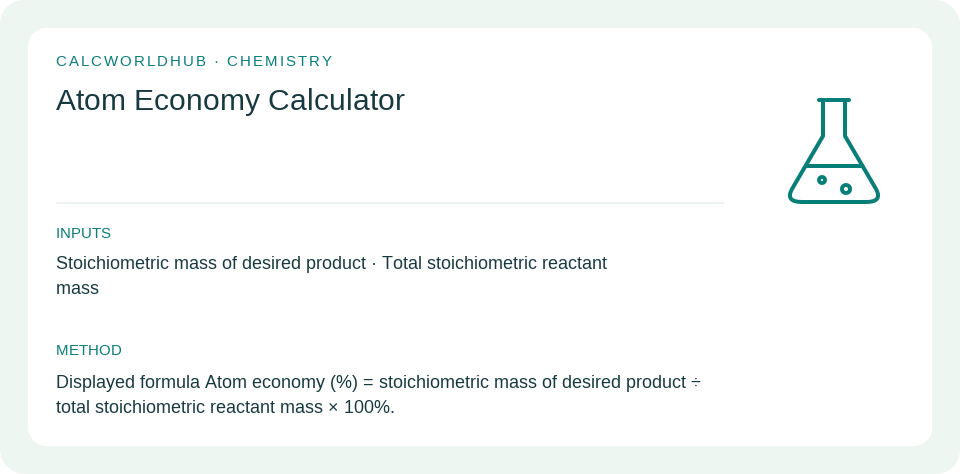
- Enter Stoichiometric mass of desired product, Total stoichiometric reactant mass. Match the units shown beside each field and review the result together with the assumptions below.
- Read the worked example below to check the expected input format and result.
- Compare another scenario by changing one input at a time. Use Reset to return to the starting values.
How this calculation works
Atom economy is a theoretical measure of how a balanced reaction assigns reactant mass to the desired product. It can compare reaction routes before experimental recovery is known, so it answers a different question from isolated percent yield.
Inputs and units
desiredMass— Stoichiometric mass of desired product- Molar mass multiplied by the product coefficient, in grams per balanced reaction as written.
reactantMass— Total stoichiometric reactant mass- Sum of coefficient × molar mass for all reactants, in grams on the same reaction basis.
Formula
Atom economy (%) = stoichiometric mass of desired product ÷ total stoichiometric reactant mass × 100%.
Method
Use coefficients from the balanced equation. Multiply the desired product's molar mass by its coefficient; calculate the total reactant mass on the same reaction basis; then divide the first mass by the second.
Worked example
For 180.16 g of stoichiometric desired product from 280.32 g of reactants, atom economy is 180.16 ÷ 280.32 × 100 = 64.27%.
Assumptions and limits
The entered masses must come from the same balanced equation and reaction basis. This theoretical metric does not measure actual conversion, isolated yield, toxicity, solvent use, energy use, or waste-treatment burden.
Frequently asked questions
Does atom economy use actual product yield?
No. It is calculated from the balanced reaction and molar masses, not an experiment's recovered product.
Can atom economy be 100%?
Yes, if the balanced equation assigns all stoichiometric reactant mass to the desired product.
Does high atom economy guarantee a greener process?
No. It omits factors such as solvents, energy, hazards, purification, and actual yield.
How do I use the Atom Economy Calculator?
Enter Stoichiometric mass of desired product, Total stoichiometric reactant mass. Match the units shown beside each field and review the result together with the assumptions below.
What is a worked example of Atom Economy?
For 180.16 g of stoichiometric desired product from 280.32 g of reactants, atom economy is 180.16 ÷ 280.32 × 100 = 64.27%.
Reference: OpenStax Chemistry and LibreTexts reaction-yield or atom-economy reference. See our calculation methodology.