Theoretical yield calculator
Convert limiting-reactant moles into a stoichiometric product-mass estimate.
inputs.
Calculator
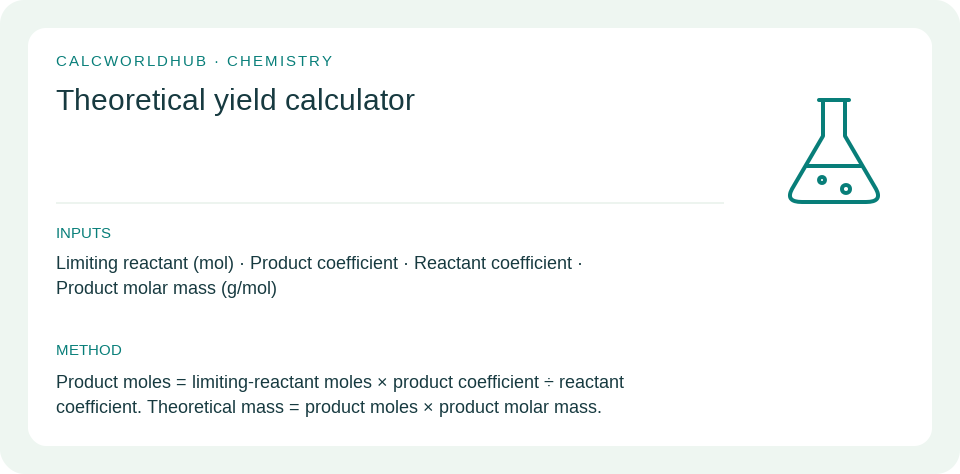
How to use this calculator
Calculate theoretical product mass from limiting-reactant amount, balanced coefficients, and molar mass.
- Enter Limiting reactant (mol), Product coefficient, Reactant coefficient, Product molar mass (g/mol). Match the units shown beside each field and review the result together with the assumptions below.
- Read the worked example below to check the expected input format and result.
- Compare another scenario by changing one input at a time. Use Reset to return to the starting values.
Convert limiting-reactant moles into product mass
Use a balanced reaction’s stoichiometric coefficients to determine the maximum product amount before accounting for losses.
Inputs and units
- Limiting reactant (mol): Moles of the reactant identified as limiting by the balanced reaction.
- Product coefficient: Stoichiometric coefficient of the desired product.
- Reactant coefficient: Stoichiometric coefficient of the limiting reactant.
- Product molar mass (g/mol): Molar mass of the desired product.
Formula and method
Product moles = limiting-reactant moles × product coefficient ÷ reactant coefficient. Theoretical mass = product moles × product molar mass.
Worked example
For 0.25 mol limiting reactant, product coefficient 2, reactant coefficient 1, and product molar mass 18.015 g/mol: 0.25 × 2 ÷ 1 × 18.015 = 9.0075 g.
Interpreting the result
This is the stoichiometric maximum for the stated reaction and limiting-reactant amount. An actual experiment may produce less product.
Assumptions and limits
Requires a correctly balanced chemical equation and the correct limiting reactant. It assumes complete reaction and excludes side reactions, incomplete conversion, purification loss, and measurement uncertainty.
Method references
Frequently asked questions
Is theoretical yield the amount collected?
No. It is the calculated maximum; actual yield is measured experimentally and is often lower.
How is percent yield calculated?
Percent yield = actual yield ÷ theoretical yield × 100%, using matching product and mass units.
How do I use the Theoretical yield calculator?
Enter Limiting reactant (mol), Product coefficient, Reactant coefficient, Product molar mass (g/mol). Match the units shown beside each field and review the result together with the assumptions below.
What is a worked example of Theoretical yield?
For 0.25 mol limiting reactant, product coefficient 2, reactant coefficient 1, and product molar mass 18.015 g/mol: 0.25 × 2 ÷ 1 × 18.015 = 9.0075 g.
What does the Theoretical yield calculator calculate?
Calculate theoretical product mass from limiting-reactant amount, balanced coefficients, and molar mass.
Good calculators show their work.
CalcWorldHub is built around clear inputs and visible assumptions. Results are estimates for planning; check official sources or your provider’s terms when exact figures matter.