Limiting reagent product moles calculator
Use stoichiometric coefficients to find product moles limited by two reactants.
Related calculators and articles
Compare methods and explore more free tools in chemistry.
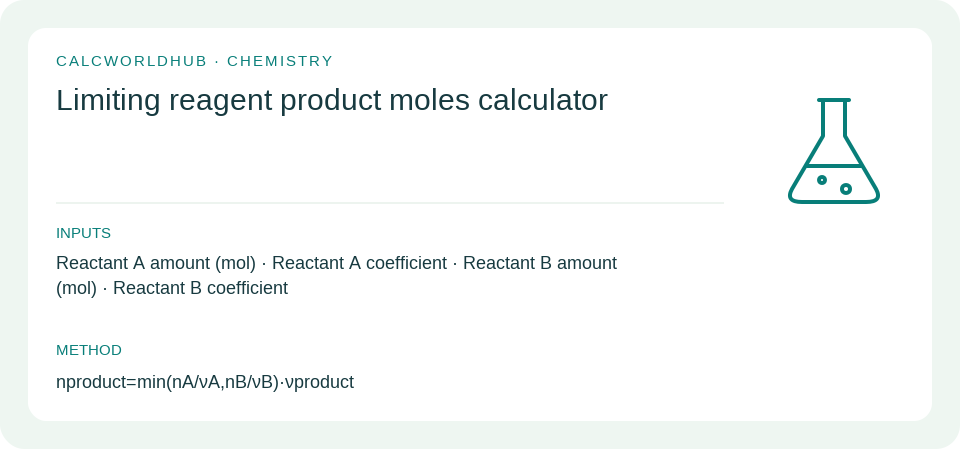
How to use this calculator
Use stoichiometric coefficients to find product moles limited by two reactants.
- Enter Reactant A amount (mol), Reactant A coefficient, Reactant B amount (mol), Reactant B coefficient, then complete the remaining labeled fields. Match the units shown beside each field and review the result together with the assumptions below.
- Read the worked example below to check the expected input format and result.
- Compare another scenario by changing one input at a time. Use Reset to return to the starting values.
Limiting reagent product moles calculator
Use stoichiometric coefficients to find product moles limited by two reactants.
Inputs and units
- Reactant A amount (mol): Available moles of reactant A before reaction.
- Reactant A coefficient: Positive balanced-equation stoichiometric coefficient for reactant A.
- Reactant B amount (mol): Available moles of reactant B before reaction.
- Reactant B coefficient: Positive balanced-equation stoichiometric coefficient for reactant B.
- Product coefficient: Balanced-equation stoichiometric coefficient for the selected product.
Formula and method
nproduct=min(nA/νA,nB/νB)·νproduct
Worked example
For 3 mol A with νA=2 and 2 mol B with νB=1, the extent is min(1.5,2)=1.5 mol; with νproduct=1, product=1.5 mol.
Interpreting the result
The smaller normalized reactant amount is limiting; the other reactant remains in excess under the stated reaction equation.
Assumptions and limits
Amounts must be nonnegative and stoichiometric coefficients positive. Assumes a balanced reaction, complete conversion to the limiting extent, and no side reactions or yield loss.
Sources and method
- Defines solution concentration as solute amount per solution volume; the dilution calculation conserves solute amount. OpenStax Chemistry 2e: molarity
Frequently asked questions
What does this limiting reagent product moles result tell me?
The smaller normalized reactant amount is limiting; the other reactant remains in excess under the stated reaction equation.
What assumptions should I check?
Amounts must be nonnegative and stoichiometric coefficients positive. Assumes a balanced reaction, complete conversion to the limiting extent, and no side reactions or yield loss.
How do I use the Limiting reagent product moles calculator?
Enter Reactant A amount (mol), Reactant A coefficient, Reactant B amount (mol), Reactant B coefficient, then complete the remaining labeled fields. Match the units shown beside each field and review the result together with the assumptions below.
What is a worked example of Limiting reagent product moles?
For 3 mol A with νA=2 and 2 mol B with νB=1, the extent is min(1.5,2)=1.5 mol; with νproduct=1, product=1.5 mol.
What does the Limiting reagent product moles calculator calculate?
Use stoichiometric coefficients to find product moles limited by two reactants.
See the calculation methodology.