How to use this calculator
Estimate dew point from air temperature and relative humidity with a vapor-pressure calculation.
- Enter Air temperature, Relative humidity. Match the units shown beside each field and review the result together with the assumptions below.
- Read the worked example below to check the expected input format and result.
- Compare another scenario by changing one input at a time. Use Reset to return to the starting values.
How this calculation works
Relative humidity describes moisture relative to what air can hold at its current temperature, so the same percentage can represent different moisture levels on warm and cool days. Dew point expresses that moisture as the temperature at which saturation is reached under the chosen approximation.
Inputs and units
temperatureC— Air temperature- Dry-bulb air temperature in degrees Celsius (°C).
relativeHumidity— Relative humidity- Relative humidity as a percentage greater than 0 and no greater than 100. Enter 70 for 70%.
Formula
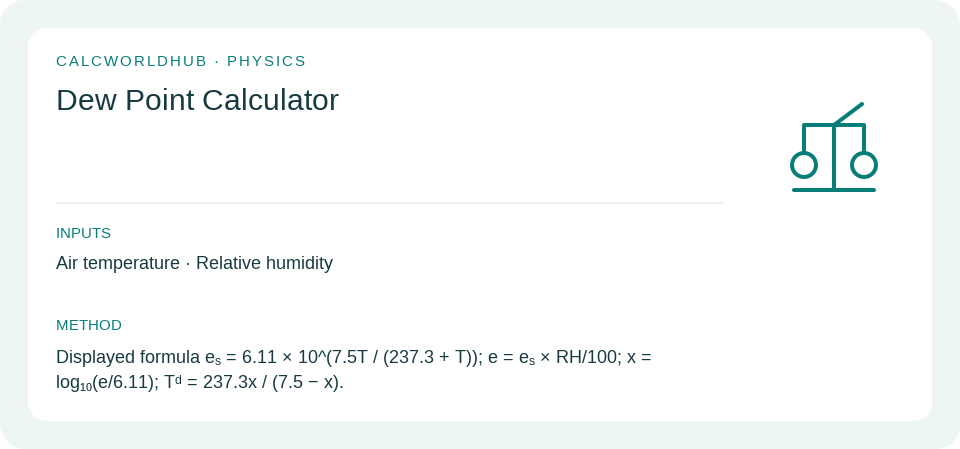
eₛ = 6.11 × 10^(7.5T / (237.3 + T)); e = eₛ × RH/100; x = log₁₀(e/6.11); Tᵈ = 237.3x / (7.5 − x).
Method
Temperature T is entered in °C and relative humidity RH in percent. The calculator first estimates saturation vapor pressure eₛ in hPa, scales it by RH to obtain actual vapor pressure e, then inverts the same base-10 vapor-pressure relationship for dew-point temperature Tᵈ. It follows the National Weather Service vapor-pressure form and is a near-surface estimate.
Worked example
At 30 °C and 70% relative humidity, saturation vapor pressure is about 42.4 hPa and actual vapor pressure is about 29.7 hPa. Inverting the relationship gives a dew point of about 23.9 °C, roughly 6.1 °C below the air temperature.
Assumptions and limits
This compact empirical relationship is intended for ordinary near-surface conditions and uses a liquid-water saturation reference. It does not apply a station-pressure correction or replace an observed dew point; values below freezing can differ when saturation over ice is used. Temperature is limited to −40 through 50 °C and relative humidity must be above zero and at most 100%.
Frequently asked questions
Can dew point be higher than air temperature?
For a consistent unsaturated near-surface measurement, dew point is at or below air temperature. A higher result usually means the units, measurements, or inputs are inconsistent.
Why can dew point describe moisture better than relative humidity alone?
Relative humidity changes when temperature changes even if water-vapor content stays the same. Dew point is a temperature measure tied more directly to the current vapor content.
Does this estimate account for altitude or station pressure?
No. It uses temperature and relative humidity only. Other psychrometric calculations may use station pressure.
How do I use the Dew Point Calculator?
Enter Air temperature, Relative humidity. Match the units shown beside each field and review the result together with the assumptions below.
What is a worked example of Dew Point?
At 30 °C and 70% relative humidity, saturation vapor pressure is about 42.4 hPa and actual vapor pressure is about 29.7 hPa. Inverting the relationship gives a dew point of about 23.9 °C, roughly 6.1 °C below the air temperature.
Reference: National Weather Service dew-point equation from temperature and relative humidity. See our calculation methodology.