How to use this calculator
Find the outgoing diffraction angle for a specified order and an ideal groove-count resolving power.
- Enter Groove density (lines/mm), Vacuum wavelength (nm), Signed incidence angle from normal (degrees), Signed diffraction order, then complete the remaining labeled fields. Match the units shown beside each field and review the result together with the assumptions below.
- Read the worked example below to check the expected input format and result.
- Compare another scenario by changing one input at a time. Use Reset to return to the starting values.
Diffraction grating order angle explained
Find the signed diffraction angle for a selected grating order and estimate ideal resolving power from illuminated groove count.
How the calculation works
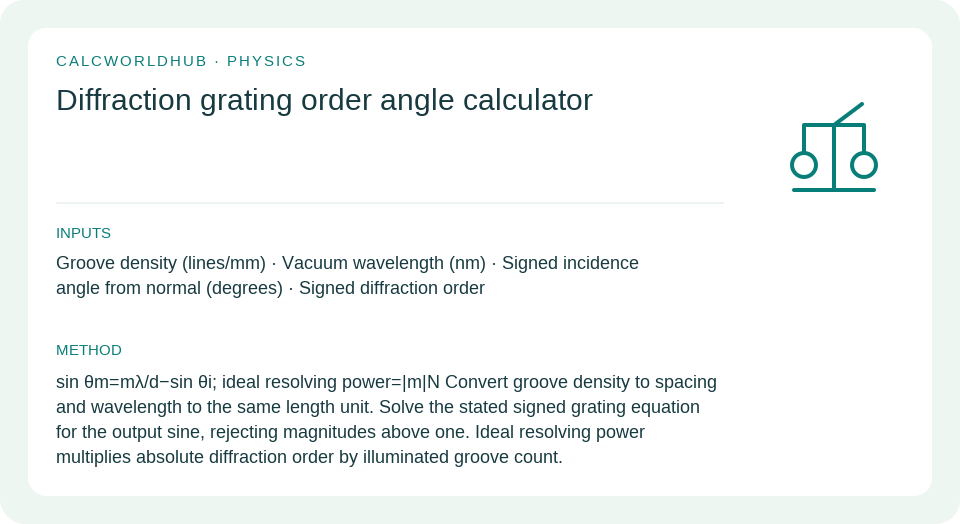
sin θm=mλ/d−sin θi; ideal resolving power=|m|N
Convert groove density to spacing and wavelength to the same length unit. Solve the stated signed grating equation for the output sine, rejecting magnitudes above one. Ideal resolving power multiplies absolute diffraction order by illuminated groove count.
Set up the calculation
g— Groove density (lines/mm)- Number of grooves per millimetre; reciprocal density gives groove spacing.
l— Vacuum wavelength (nm)- Incident vacuum wavelength in nanometres, converted to the same length unit as spacing.
i— Signed incidence angle from normal (degrees)- Signed incident ray angle measured from the grating normal.
m— Signed diffraction order- Signed integer diffraction order; zero is the specular order.
w— Illuminated grating width (mm)- Width illuminated across the grooves; width times groove density gives the ideal groove count.
Limits of this model
Reflection/transmission sign conventions differ; this page explicitly uses sin θm+sin θi=mλ/d. Blaze efficiency and finite slit width are excluded.
Check this example
Groove density (lines/mm) = 600; Vacuum wavelength (nm) = 500; Signed incidence angle from normal (degrees) = 0; Signed diffraction order = 1; Illuminated grating width (mm) = 20.
- Diffracted order angle: 17.45760312 degrees
- Ideal groove-count resolving power: 12000
Interpreting the result
The signed angle is measured from the grating normal using the page’s sign convention. A missing or evanescent order has no real diffraction angle; ideal resolving power is order times the number of illuminated grooves.
Frequently asked questions
What if the sine magnitude exceeds one?
That order does not propagate and the input is rejected.
Can negative orders be entered?
Yes, using the displayed signed convention.
Does ideal resolving power guarantee instrument resolution?
No, illumination, slit width, and aberrations also matter.
How do I use the Diffraction grating order angle calculator?
Enter Groove density (lines/mm), Vacuum wavelength (nm), Signed incidence angle from normal (degrees), Signed diffraction order, then complete the remaining labeled fields. Match the units shown beside each field and review the result together with the assumptions below.
What is a worked example of Diffraction grating order angle?
Groove density (lines/mm) = 600; Vacuum wavelength (nm) = 500; Signed incidence angle from normal (degrees) = 0; Signed diffraction order = 1; Illuminated grating width (mm) = 20. Diffracted order angle: 17.45760312 degrees Ideal groove-count resolving power: 12000