How to use this calculator
Measure a local nonlinear energy proxy sensitive to both amplitude and oscillation rate.
- Enter Uniform samples (signal units). Match the units shown beside each field and review the result together with the assumptions below.
- Read the worked example below to check the expected input format and result.
- Compare another scenario by changing one input at a time. Use Reset to return to the starting values.
Discrete Teager Kaiser signal energy explained
This guide follows discrete teager kaiser signal energy calculator from its stated formula through a worked example, then identifies the assumptions that bound the result.
A numerical walkthrough
Uniform samples (signal units) = [0, 0.7071067811865476, 1, 0.7071067811865476, 0, -0.7071067811865476, -1].
- Mean Teager Kaiser energy: 0.5 signal units²
- Energy at input index 1: 0.5 signal units²
- Energy at input index 2: 0.5 signal units²
- Energy at input index 3: 0.5 signal units²
- Energy at input index 4: 0.5 signal units²
- Energy at input index 5: 0.5 signal units²
A unit sinusoid advancing pi/4 per sample produces a constant ideal operator value of one half.
The model behind the numbers
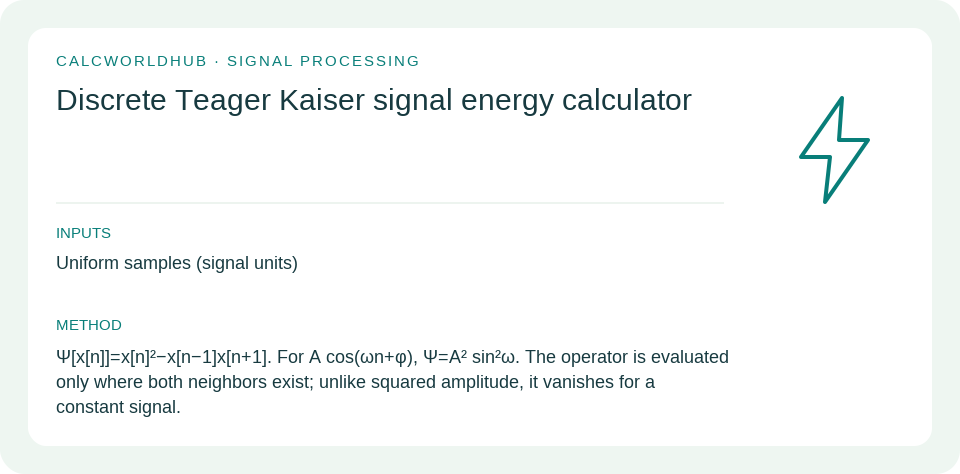
Ψ[x[n]]=x[n]²−x[n−1]x[n+1]. For A cos(ωn+φ), Ψ=A² sin²ω.
The operator is evaluated only where both neighbors exist; unlike squared amplitude, it vanishes for a constant signal.
What to enter
x— Uniform samples (signal units)- Chronological real samples; use a comma-separated list in the same signal units. Use comma-separated values in the stated order.
Interpreting the result
This is a nonlinear signal descriptor, not physical joules. Multicomponent mixtures and noise introduce cross terms.
Reading the outputs
The mean summarizes valid interior values; individual values may be negative for general signals.
Frequently asked questions
Can this energy be negative?
Yes. General signals need not satisfy a single-component sinusoidal model.
Why is a constant signal zero?
Its squared value equals the product of its equal neighbors.
Does it need the sample rate?
Not for this discrete operator; conversion to a continuous derivative model would.
How do I use the Discrete Teager Kaiser signal energy calculator?
Enter Uniform samples (signal units). Match the units shown beside each field and review the result together with the assumptions below.
What is a worked example of Discrete Teager Kaiser signal energy?
Uniform samples (signal units) = [0, 0.7071067811865476, 1, 0.7071067811865476, 0, -0.7071067811865476, -1]. Mean Teager Kaiser energy: 0.5 signal units² Energy at input index 1: 0.5 signal units² Energy at input index 2: 0.5 signal units² Energy at input index 3: 0.5 signal units² Energy at input index 4: 0.5 signal units² Energy at input index 5: 0.5 signal units² A unit sinusoid advancing pi/4 per sample produces a constant ideal operator value of one half.
Read our calculation methodology.