How to use this calculator
Locate the energy-weighted arrival time and temporal spread of a pulse or short transient.
- Enter Uniform samples (signal units), Sampling frequency (Hz). Match the units shown beside each field and review the result together with the assumptions below.
- Read the worked example below to check the expected input format and result.
- Compare another scenario by changing one input at a time. Use Reset to return to the starting values.
Signal energy centroid and duration explained
Use Uniform samples (signal units) with Sampling frequency (Hz) to reproduce the sample calculation, then review the stated limits before carrying the result into another scenario.
A numerical walkthrough
Uniform samples (signal units) = [0, 1, 2, 1, 0, 0.5, 0]; Sampling frequency (Hz) = 10.
- Energy centroid time: 0.212 s
- RMS temporal width: 0.081584 s
- Integrated squared signal: 0.625 signal units²·s
The default pulse peaks at 0.2 seconds but has a small later tail, so its energy centroid shifts after the peak.
The model behind the numbers
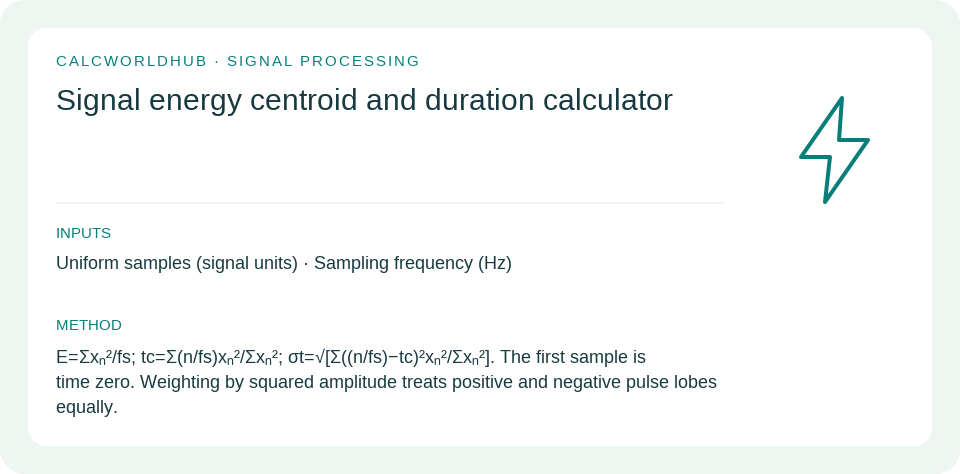
E=Σxₙ²/fs; tc=Σ(n/fs)xₙ²/Σxₙ²; σt=√[Σ((n/fs)−tc)²xₙ²/Σxₙ²].
The first sample is time zero. Weighting by squared amplitude treats positive and negative pulse lobes equally.
What to enter
x— Uniform samples (signal units)- Chronological real samples; use a comma-separated list in the same signal units. Use comma-separated values in the stated order.
fs— Sampling frequency (Hz)- Uniform samples per second; must be positive.
Interpreting the result
Uniform samples only; absolute arrival time requires adding the record start timestamp. An all-zero record is undefined.
Reading the outputs
Temporal width is an energy-weighted standard deviation, not a threshold-based pulse width.
Frequently asked questions
Does changing pulse polarity change the centroid?
No; squared amplitudes are unchanged.
Is this the same as the highest-sample time?
No. A weak long tail can shift the energy centroid.
Why divide total energy by sample rate?
It converts a squared sample sum into a time-integrated squared signal.
How do I use the Signal energy centroid and duration calculator?
Enter Uniform samples (signal units), Sampling frequency (Hz). Match the units shown beside each field and review the result together with the assumptions below.
What is a worked example of Signal energy centroid and duration?
Uniform samples (signal units) = [0, 1, 2, 1, 0, 0.5, 0]; Sampling frequency (Hz) = 10. Energy centroid time: 0.212 s RMS temporal width: 0.081584 s Integrated squared signal: 0.625 signal units²·s The default pulse peaks at 0.2 seconds but has a small later tail, so its energy centroid shifts after the peak.
Read our calculation methodology.