How to use this calculator
Estimate freshwater dissolved-oxygen saturation and compare a measured reading with the temperature and barometric pressure.
- Enter Water temperature (°C), Barometric pressure (kPa), Measured dissolved oxygen (mg/L). Match the units shown beside each field and review the result together with the assumptions below.
- Read the worked example below to check the expected input format and result.
- Compare another scenario by changing one input at a time. Use Reset to return to the starting values.
How this calculation works
A dissolved-oxygen reading is easier to interpret when compared with the concentration expected at air saturation. This tool estimates that freshwater reference value, then reports the measured sample as a percentage of saturation and its concentration difference.
Inputs and units
temperature— Water temperature (°C)- Temperature of the sample, from 0 to 40 °C.
pressure— Barometric pressure (kPa)- Absolute station pressure at the sample location.
measured— Measured dissolved oxygen (mg/L)- Field or laboratory dissolved-oxygen reading; may exceed saturation.
Formula
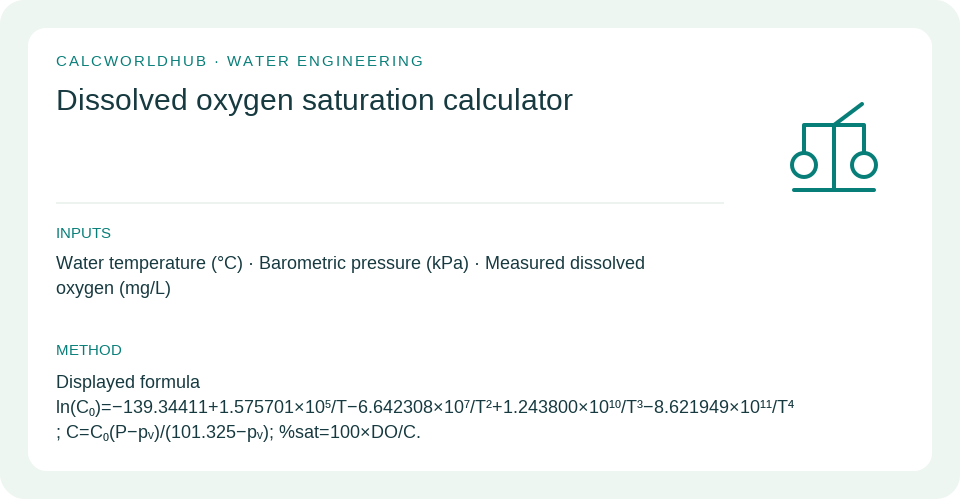
ln(C₀)=−139.34411+1.575701×10⁵/T−6.642308×10⁷/T²+1.243800×10¹⁰/T³−8.621949×10¹¹/T⁴; C=C₀(P−pᵥ)/(101.325−pᵥ); %sat=100×DO/C.
Method
T is water temperature in kelvin, P is absolute barometric pressure in kPa, pᵥ is saturation vapor pressure of water at the entered temperature, C₀ is freshwater oxygen solubility at standard pressure, and DO is the measured dissolved oxygen in mg/L.
Worked example
At 20 °C and 101.325 kPa, freshwater saturation is about 9.09 mg/L. A measured 8.00 mg/L is approximately 88.0% saturation, leaving an estimated deficit of 1.09 mg/L.
Assumptions and limits
This is a freshwater equilibrium estimate for 0–40 °C and 60–110 kPa. It does not correct for salinity or unusual gas mixtures, and an observed supersaturation can occur. Use the barometric pressure at the sampling location, not a weather app’s sea-level-adjusted pressure.
Frequently asked questions
Does this include salinity?
No. Salt lowers oxygen solubility; use a salinity-corrected method for brackish or seawater.
Can percent saturation be above 100%?
Yes. Photosynthesis, rapid temperature change, or measurement conditions can produce supersaturation.
Which pressure should I enter?
Use local station pressure at sampling elevation; do not use a sea-level-corrected forecast value.
How do I use the Dissolved oxygen saturation calculator?
Enter Water temperature (°C), Barometric pressure (kPa), Measured dissolved oxygen (mg/L). Match the units shown beside each field and review the result together with the assumptions below.
What is a worked example of Dissolved oxygen saturation?
At 20 °C and 101.325 kPa, freshwater saturation is about 9.09 mg/L. A measured 8.00 mg/L is approximately 88.0% saturation, leaving an estimated deficit of 1.09 mg/L.
Reference: USGS DOTABLES dissolved-oxygen solubility method. See our calculation methodology.