Distance between parallel lines calculator
Find the perpendicular separation of two parallel lines with matching x and y coefficients.
How to use this calculator
Find the perpendicular separation of two parallel lines with matching x and y coefficients.
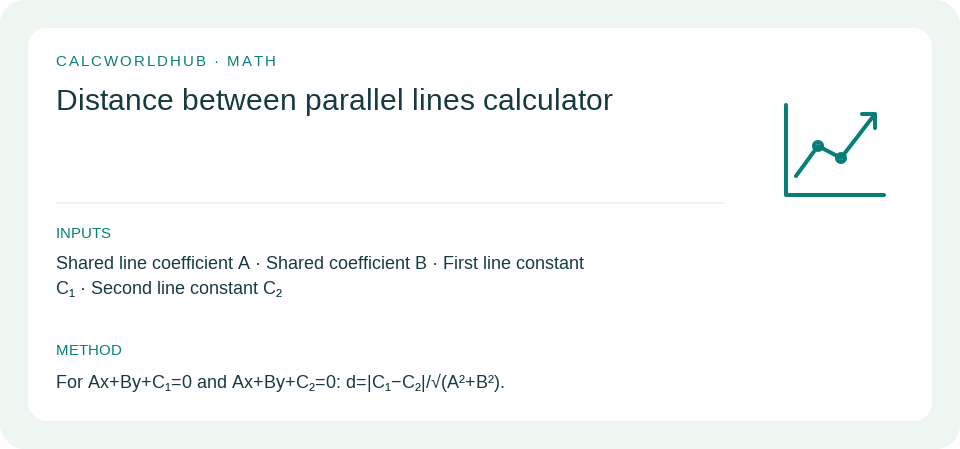
- Enter Shared line coefficient A, Shared coefficient B, First line constant C₁, Second line constant C₂. Match the units shown beside each field and review the result together with the assumptions below.
- Read the worked example below to check the expected input format and result.
- Compare another scenario by changing one input at a time. Use Reset to return to the starting values.
How the Distance between parallel lines calculator works
Find the perpendicular separation of two parallel lines with matching x and y coefficients.
Inputs and units
- Shared line coefficient A: Shared coefficient A multiplies x in both line equations.
- Shared coefficient B: Shared coefficient B multiplies y in both line equations.
- First line constant C₁: C₁ is the first line’s constant term.
- Second line constant C₂: C₂ is the second line’s constant term.
Formula and method
For Ax+By+C₁=0 and Ax+By+C₂=0: d=|C₁−C₂|/√(A²+B²).
Worked example
For 3x+4y−5=0 and 3x+4y+15=0, d=|−5−15|/5=4 units.
Interpreting the result
The absolute value removes line-order direction. The normal coefficient scale cancels when both equations use the same A and B.
Assumptions and limits
The lines must share the same A,B pair; rescale C values consistently if rescaling the equations. A=B=0 does not define a line.
Frequently asked questions
Why must both equations use the same A and B?
That makes the normals parallel; C₁ and C₂ then describe offsets along the shared normal.
Does scaling each line independently change the separation?
Only if each entire equation is scaled consistently, including its C term.
How do I use the Distance between parallel lines calculator?
Enter Shared line coefficient A, Shared coefficient B, First line constant C₁, Second line constant C₂. Match the units shown beside each field and review the result together with the assumptions below.
What is a worked example of Distance between parallel lines?
For 3x+4y−5=0 and 3x+4y+15=0, d=|−5−15|/5=4 units.
What does the Distance between parallel lines calculator calculate?
Find the perpendicular separation of two parallel lines with matching x and y coefficients.
See the calculation methodology.