Distance from recession velocity and Hubble constant calculator
Estimate a nearby galaxy’s distance from recession velocity using the linear Hubble law. Enter your values below to see the result and method.
inputs.
Related calculators
These tools cover nearby questions while keeping this page focused on its own calculation.
How to use this calculator
Estimate a nearby galaxy’s distance from recession velocity using the linear Hubble law.
- Enter Recession velocity (km/s), Hubble constant H₀ (km/s/Mpc). Match the units shown beside each field and review the result together with the assumptions below.
- Read the worked example below to check the expected input format and result.
- Compare another scenario by changing one input at a time. Use Reset to return to the starting values.
Choose the observed quantity and convention
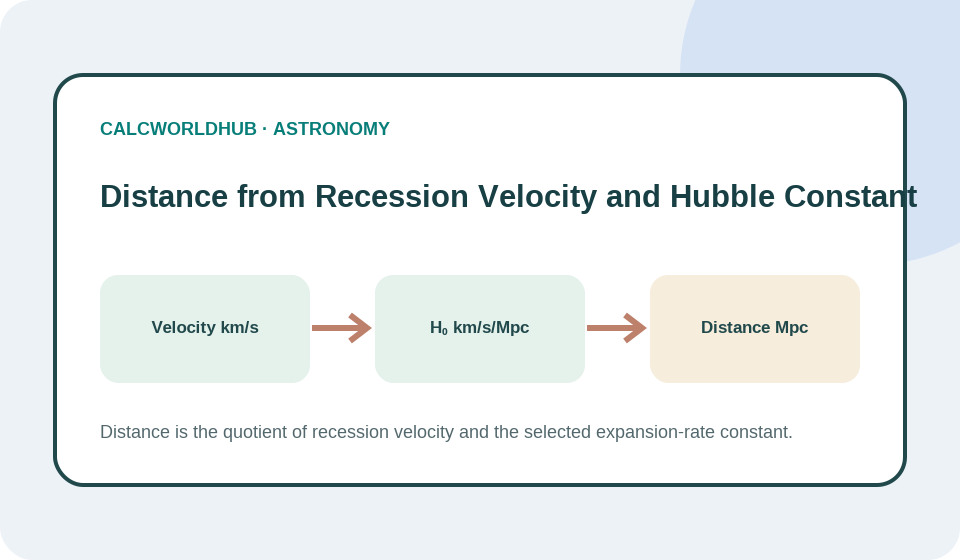
For a nearby galaxy with a measured recession velocity, divide velocity by the adopted Hubble constant to obtain a low-redshift distance estimate.
Inputs and units
Use the units printed beside each field. These values are Recession velocity (km/s), Hubble constant H₀ (km/s/Mpc).
- Recession velocity (km/s): Recession velocity as defined for the physical or engineering situation.
- Hubble constant H₀ (km/s/Mpc): Hubble constant H₀ as defined for the physical or engineering situation.
Observation equation and example
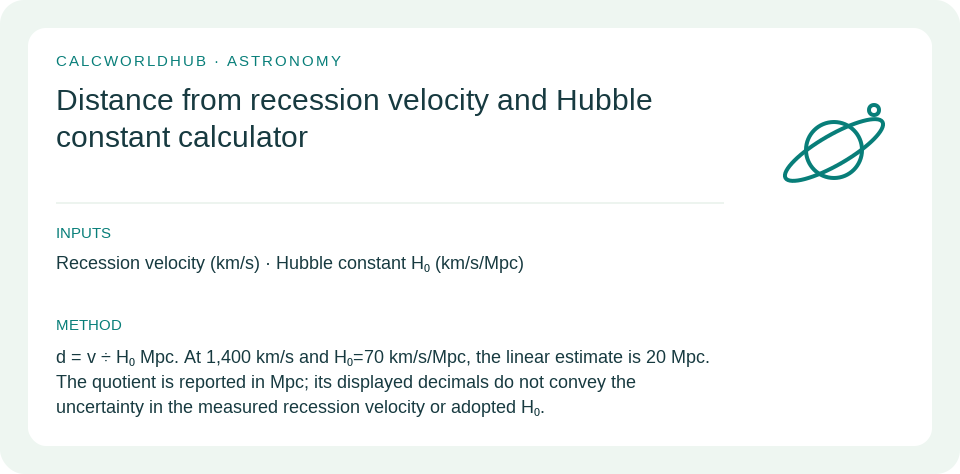
d = v ÷ H₀ Mpc.
At 1,400 km/s and H₀=70 km/s/Mpc, the linear estimate is 20 Mpc.
The quotient is reported in Mpc; its displayed decimals do not convey the uncertainty in the measured recession velocity or adopted H₀.
Know which physical interpretation applies
This calculation takes recession velocity as its input. If the observation is a small redshift, first convert it with a low-redshift relation and keep peculiar motion in mind.
Assumptions and limitations
The linear relation is a low-redshift approximation; peculiar velocities can dominate for nearby galaxies and cosmological distance definitions differ at high redshift.
Frequently asked questions
Which values are needed for the distance from recession velocity and hubble constant?
Enter recession velocity in km/s and H₀ in km/s/Mpc; their ratio has units of megaparsecs (Mpc).
Does this distance from recession velocity and hubble constant include real-world effects?
The linear relation is a low-redshift approximation; peculiar velocities can dominate for nearby galaxies and cosmological distance definitions differ at high redshift.
When should I use a low-redshift velocity estimate before this distance calculation?
Use the low-redshift velocity tool when you start with a small measured redshift and need an approximate recession speed. This page takes recession speed and an adopted Hubble constant to estimate distance.
How do I use the Distance from recession velocity and Hubble constant calculator?
Enter Recession velocity (km/s), Hubble constant H₀ (km/s/Mpc). Match the units shown beside each field and review the result together with the assumptions below.
What is a worked example of Distance from recession velocity and Hubble constant?
d = v ÷ H₀ Mpc. At 1,400 km/s and H₀=70 km/s/Mpc, the linear estimate is 20 Mpc. The quotient is reported in Mpc; its displayed decimals do not convey the uncertainty in the measured recession velocity or adopted H₀.
Read the calculation methodology and privacy policy.
Method source: NASA Science, Hubble’s Law.