How to use this calculator
Approximate a dominant real eigenpair by repeated matrix-vector multiplication and check its eigen-residual.
- Enter Matrix entries, row-major, Initial direction, Power iterations. Match the units shown beside each field and review the result together with the assumptions below.
- Read the worked example below to check the expected input format and result.
- Compare another scenario by changing one input at a time. Use Reset to return to the starting values.
Dominant eigenpair power iteration explained
Approximate a dominant real eigenpair by repeated matrix-vector multiplication and check its eigen-residual.
How the calculation works
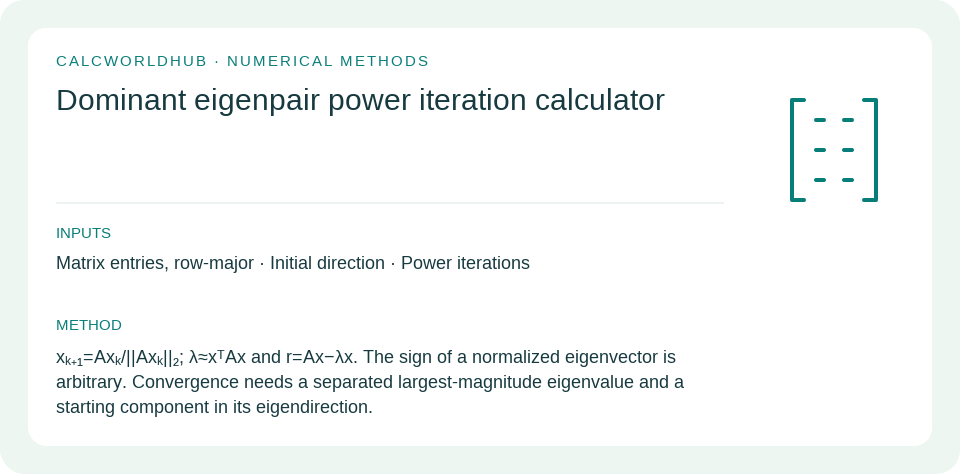
xₖ₊₁=Axₖ/||Axₖ||₂; λ≈xᵀAx and r=Ax−λx.
The sign of a normalized eigenvector is arbitrary. Convergence needs a separated largest-magnitude eigenvalue and a starting component in its eigendirection.
Set up the calculation
a— Matrix entries, row-major- Square matrix, entered row by row; 2–10 rows are supported. Use comma-separated values in the stated order.
x— Initial direction- Nonzero starting vector, not orthogonal to the desired eigenvector. Use comma-separated values in the stated order.
steps— Power iterations- Matrix-vector normalization steps. Enter a whole number.
Limits of this model
Complex dominant pairs, equal-magnitude eigenvalues and defective matrices need other methods. This page does not return every eigenvalue.
Check this example
Matrix entries, row-major = [4, 1, 0, 1, 3, 1, 0, 1, 2]; Initial direction = [1, 1, 1]; Power iterations = 25.
- Rayleigh eigenvalue estimate: 4.732051
- Eigenpair residual norm: 0.000007
- First normalized vector component: 0.788673
- Complete normalized eigenvector: 0.788672753656, 0.577352650117, 0.211327246335 component order
Twenty-five iterations on the default symmetric matrix converge toward its largest eigenvalue, approximately 4.73205.
Reading the outputs
Rayleigh estimate has matrix eigenvalue units; residual is a 2-norm. The first vector component helps identify the iterate orientation. The complete solved vector or profile is also listed in the original component order, so no coordinate is hidden.
Frequently asked questions
Can the dominant eigenvalue be negative?
Yes. The direction alternates sign, while the Rayleigh quotient tends to the signed eigenvalue.
Why might the result change slowly?
A small spectral gap gives a convergence ratio near one.
Is the first component a unique eigenvector definition?
No; normalization fixes length but not overall sign.
How do I use the Dominant eigenpair power iteration calculator?
Enter Matrix entries, row-major, Initial direction, Power iterations. Match the units shown beside each field and review the result together with the assumptions below.
What is a worked example of Dominant eigenpair power iteration?
Matrix entries, row-major = [4, 1, 0, 1, 3, 1, 0, 1, 2]; Initial direction = [1, 1, 1]; Power iterations = 25. Rayleigh eigenvalue estimate: 4.732051 Eigenpair residual norm: 0.000007 First normalized vector component: 0.788673 Complete normalized eigenvector: 0.788672753656, 0.577352650117, 0.211327246335 component order Twenty-five iterations on the default symmetric matrix converge toward its largest eigenvalue, approximately 4.73205.
Background or definition reference: NIST DLMF numerical methods.
Read our calculation methodology.