How to use this calculator
Bound the real-axis extent of all Gershgorin discs before attempting an eigenvalue solve.
- Enter Matrix entries, row-major. Match the units shown beside each field and review the result together with the assumptions below.
- Read the worked example below to check the expected input format and result.
- Compare another scenario by changing one input at a time. Use Reset to return to the starting values.
Gershgorin eigenvalue enclosure explained
This guide follows gershgorin eigenvalue enclosure calculator from its stated formula through a worked example, then identifies the assumptions that bound the result.
A numerical walkthrough
Matrix entries, row-major = [4, 1, 0, 1, 3, 1, 0, 1, 2].
- Leftmost disc real extent: 1
- Rightmost disc real extent: 5
- Smallest absolute diagonal dominance margin: 1
The default matrix has disc extents spanning 1 to 5; its exact eigenvalues lie within that enclosure.
The model behind the numbers
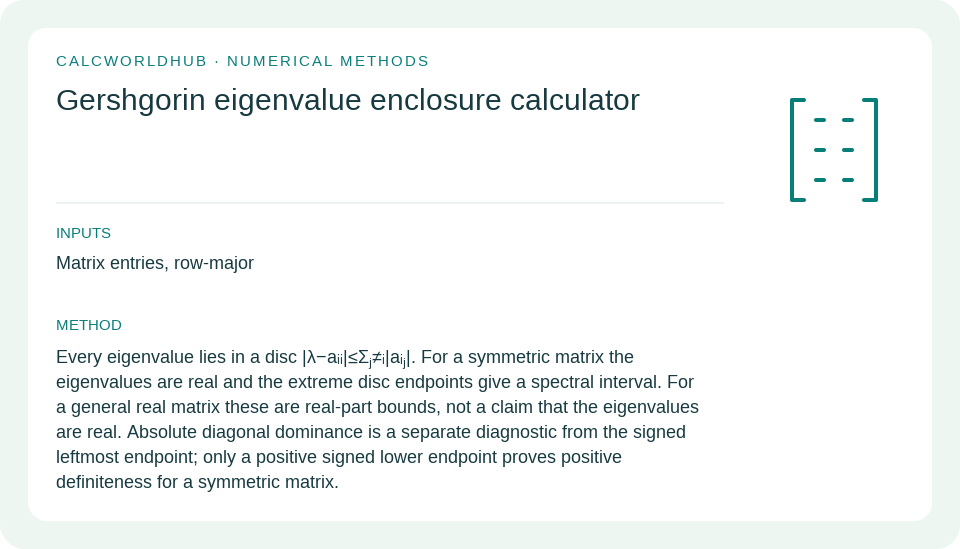
Every eigenvalue lies in a disc |λ−aᵢᵢ|≤Σⱼ≠ᵢ|aᵢⱼ|.
For a symmetric matrix the eigenvalues are real and the extreme disc endpoints give a spectral interval. For a general real matrix these are real-part bounds, not a claim that the eigenvalues are real. Absolute diagonal dominance is a separate diagnostic from the signed leftmost endpoint; only a positive signed lower endpoint proves positive definiteness for a symmetric matrix.
What to enter
a— Matrix entries, row-major- Square matrix, entered row by row; 2–10 rows are supported. Use comma-separated values in the stated order.
Interpreting the result
The union of discs is replaced by its enclosing real interval, so gaps are not reported. A negative lower endpoint does not prove a negative eigenvalue.
Reading the outputs
The first two endpoints bound eigenvalue real parts. The third output is min_i(|Aii|−sum_j≠i|Aij|): a positive value proves strict row diagonal dominance, even for negative diagonal entries.
Frequently asked questions
Can this prove a symmetric matrix is positive definite?
A strictly positive lower endpoint is sufficient, though not necessary.
Can complex eigenvalues lie outside the interval vertically?
Yes. The displayed interval bounds real parts only.
Why are bounds sometimes loose?
Absolute off-diagonal row sums ignore cancellation and interactions among rows.
How do I use the Gershgorin eigenvalue enclosure calculator?
Enter Matrix entries, row-major. Match the units shown beside each field and review the result together with the assumptions below.
What is a worked example of Gershgorin eigenvalue enclosure?
Matrix entries, row-major = [4, 1, 0, 1, 3, 1, 0, 1, 2]. Leftmost disc real extent: 1 Rightmost disc real extent: 5 Smallest absolute diagonal dominance margin: 1 The default matrix has disc extents spanning 1 to 5; its exact eigenvalues lie within that enclosure.
Background or definition reference: Ohio State University Ximera, Gershgorin’s Theorem.
Read our calculation methodology.