How to use this calculator
Split ideal engine heat addition between a constant-volume pressure rise and a constant-pressure expansion.
- Enter Compression volume ratio, Heat capacity ratio, Compression inlet temperature (K), Specific heat cp (kJ/kg/K), then complete the remaining labeled fields. Match the units shown beside each field and review the result together with the assumptions below.
- Read the worked example below to check the expected input format and result.
- Compare another scenario by changing one input at a time. Use Reset to return to the starting values.
Dual combustion cycle pressure and cutoff explained
Dual combustion adds heat first at constant volume (pressure ratio α), then at constant pressure (cutoff ratio ρ). Compression ratio and air-property inputs define the states used for ideal thermal efficiency.
A numerical walkthrough
Compression volume ratio = 16; Heat capacity ratio = 1.4; Compression inlet temperature (K) = 300; Specific heat cp (kJ/kg/K) = 1.005; Constant-volume heat-addition pressure ratio = 1.7; Constant-pressure cutoff volume ratio = 1.5.
- Thermal efficiency: 65.109811 %
- Net specific work: 803.369818 kJ/kg
- Compression exit temperature: 909.42994 K
- Heat input: 1233.869071 kJ/kg
An air-standard engine starts at 300 K with compression ratio 16, then adds heat through a 1.7 pressure rise and 1.5 cutoff ratio. Its 803.37 kJ/kg net work uses 1,233.87 kJ/kg heat input, giving 65.110% ideal efficiency; it is not a brake-efficiency prediction.
The model behind the numbers
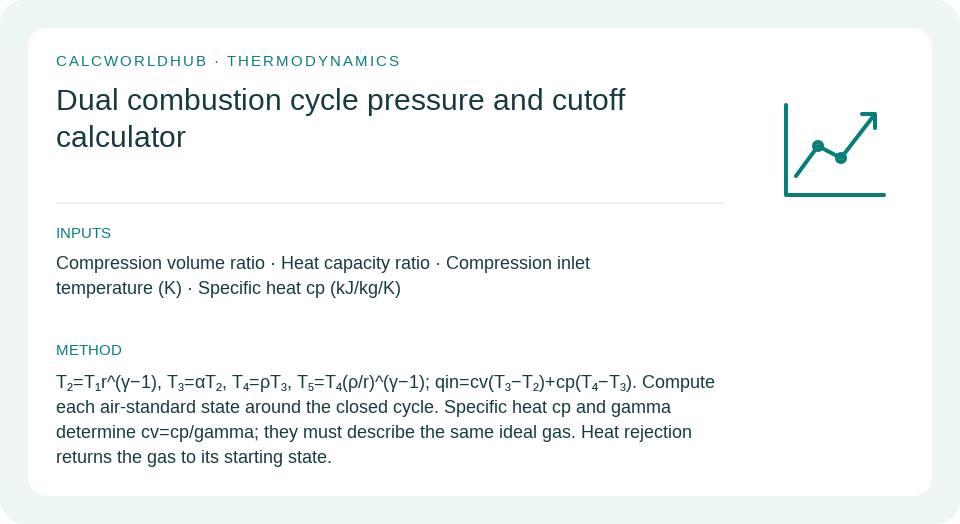
T₂=T₁r^(γ−1), T₃=αT₂, T₄=ρT₃, T₅=T₄(ρ/r)^(γ−1); qin=cv(T₃−T₂)+cp(T₄−T₃).
Compute each air-standard state around the closed cycle. Specific heat cp and gamma determine cv=cp/gamma; they must describe the same ideal gas. Heat rejection returns the gas to its starting state.
What to enter
r— Compression volume ratio- Initial cylinder volume divided by the volume after compression; dimensionless.
g— Heat capacity ratio- Specific heat at constant pressure divided by specific heat at constant volume (γ = cp/cv); dimensionless.
T— Compression inlet temperature (K)- Absolute temperature at the start of compression. Enter kelvin, not Celsius.
cp— Specific heat cp (kJ/kg/K)- Mass-specific heat at constant pressure for the same ideal gas used for γ.
pr— Constant-volume heat-addition pressure ratio- Pressure after constant-volume heat addition divided by pressure before it (α); dimensionless.
cut— Constant-pressure cutoff volume ratio- Volume after constant-pressure heat addition divided by volume before it (ρ); dimensionless.
Interpreting the result
Calorically perfect air-standard model. No fuel mass, dissociation, wall heat loss, friction, intake pumping or finite combustion rate. A geometric compression ratio alone cannot predict actual engine output.
Reading the outputs
Efficiency is net work divided by heat input; work and heat input use kJ/kg, and the compression exit uses kelvin.
Frequently asked questions
Does this include brake power?
No. Convert indicated specific work using trapped mass and cycle frequency, then account for mechanical losses.
Why does cp matter for work?
Specific heat sets the energy associated with a temperature rise; gamma governs reversible compression and expansion.
Can I use Celsius at the inlet?
No. Every absolute gas temperature in this cycle must be in kelvin.
How do I use the Dual combustion cycle pressure and cutoff calculator?
Enter Compression volume ratio, Heat capacity ratio, Compression inlet temperature (K), Specific heat cp (kJ/kg/K), then complete the remaining labeled fields. Match the units shown beside each field and review the result together with the assumptions below.
What is a worked example of Dual combustion cycle pressure and cutoff?
Compression volume ratio = 16; Heat capacity ratio = 1.4; Compression inlet temperature (K) = 300; Specific heat cp (kJ/kg/K) = 1.005; Constant-volume heat-addition pressure ratio = 1.7; Constant-pressure cutoff volume ratio = 1.5. Thermal efficiency: 65.109811 % Net specific work: 803.369818 kJ/kg Compression exit temperature: 909.42994 K Heat input: 1233.869071 kJ/kg An air-standard engine starts at 300 K with compression ratio 16, then adds heat through a 1.7 pressure rise and 1.5 cutoff ratio. Its 803.37 kJ/kg net work uses 1,233.87 kJ/kg heat input, giving 65.110% ideal efficiency; it is not a brake-efficiency prediction.
Background or definition reference: NASA Glenn ideal gas compression and expansion.
Read our calculation methodology.