How to use this calculator
Study a closed air-standard engine whose expansion stroke has a greater volume ratio than its compression stroke.
- Enter Compression volume ratio, Expansion volume ratio, Heat capacity ratio, Initial temperature (K), then complete the remaining labeled fields. Match the units shown beside each field and review the result together with the assumptions below.
- Read the worked example below to check the expected input format and result.
- Compare another scenario by changing one input at a time. Use Reset to return to the starting values.
Ideal Atkinson cycle with extended expansion explained
This closed air-standard Atkinson construction uses isentropic compression, constant-volume heat addition, extended isentropic expansion, and constant-pressure heat rejection. The two volume ratios close the cycle and determine peak temperature; this is not a variable-valve-timing engine simulation.
Inputs, symbols, and units
r— Compression volume ratio- Compression ratio V₁/V₂, greater than one.
e— Expansion volume ratio- Expansion ratio V₄/V₃; it must exceed the compression ratio for positive heat addition in this closure.
g— Heat capacity ratio- Constant ratio γ=cp/cv, greater than one.
T— Initial temperature (K)- Absolute temperature at the start of compression, in kelvin.
cp— Specific heat cp (kJ/kg/K)- Constant specific heat at constant pressure in kJ/(kg·K); the model uses cv=cp/γ.
Formula and method
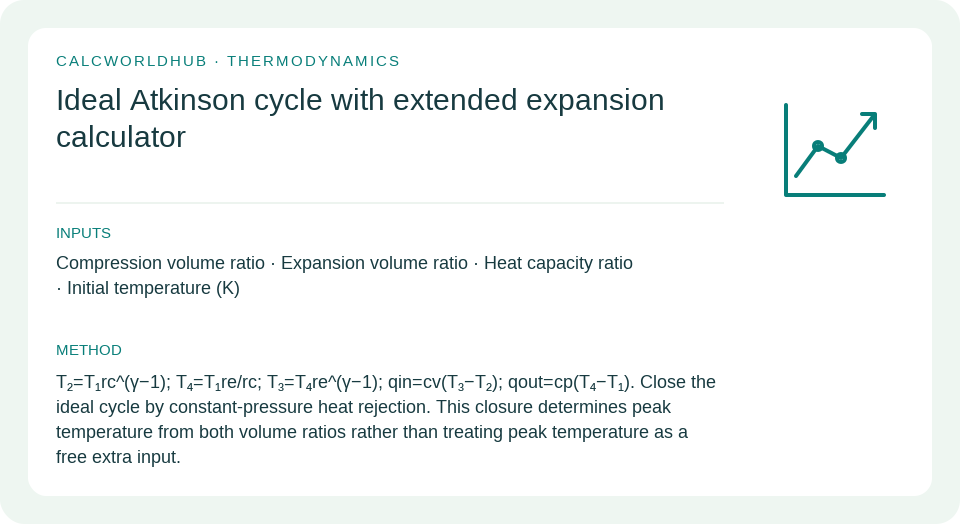
T₂=T₁rc^(γ−1); T₄=T₁re/rc; T₃=T₄re^(γ−1); qin=cv(T₃−T₂); qout=cp(T₄−T₁).
Close the ideal cycle by constant-pressure heat rejection. This closure determines peak temperature from both volume ratios rather than treating peak temperature as a free extra input.
A worked scenario
Compression volume ratio = 10; Expansion volume ratio = 15; Heat capacity ratio = 1.4; Initial temperature (K) = 300; Specific heat cp (kJ/kg/K) = 1.005.
- Thermal efficiency: 63.52987 %
- Net specific work: 262.601973 kJ/kg
- Peak temperature: 1329.379623 K
- Expansion exit temperature: 450 K
With compression ratio 10 and expansion ratio 15 from 300 K, the ideal Atkinson construction returns 262.60 kJ/kg net work at 63.530% efficiency. Expansion continues beyond the compression volume, so the result cannot be interpreted as an ordinary Otto cycle.
Assumptions and edge cases
An ideal closed Atkinson cycle, not a simulation of variable valve timing. Constant specific heats and reversible adiabatic compression/expansion are assumed.
Reading the outputs
Returns thermal efficiency, net work per gas mass, peak temperature and end-of-expansion temperature.
Frequently asked questions
Can compression and expansion ratios be equal?
That removes the heat-addition interval in this closure; this page requires extended expansion.
Is the peak temperature an input?
No. Constant-pressure rejection and the two volume ratios determine it.
Does this compare fuel consumption directly?
No. Fuel properties and real engine losses are outside this air-standard calculation.
How do I use the Ideal Atkinson cycle with extended expansion calculator?
Enter Compression volume ratio, Expansion volume ratio, Heat capacity ratio, Initial temperature (K), then complete the remaining labeled fields. Match the units shown beside each field and review the result together with the assumptions below.
What is a worked example of Ideal Atkinson cycle with extended expansion?
Compression volume ratio = 10; Expansion volume ratio = 15; Heat capacity ratio = 1.4; Initial temperature (K) = 300; Specific heat cp (kJ/kg/K) = 1.005. Thermal efficiency: 63.52987 % Net specific work: 262.601973 kJ/kg Peak temperature: 1329.379623 K Expansion exit temperature: 450 K With compression ratio 10 and expansion ratio 15 from 300 K, the ideal Atkinson construction returns 262.60 kJ/kg net work at 63.530% efficiency. Expansion continues beyond the compression volume, so the result cannot be interpreted as an ordinary Otto cycle.
Background or definition reference: NASA Glenn ideal gas compression and expansion.
Read our calculation methodology.