Economic order quantity calculator
Estimate a baseline replenishment lot size from ordering and carrying costs.
inputs.
Calculator
How to use this calculator
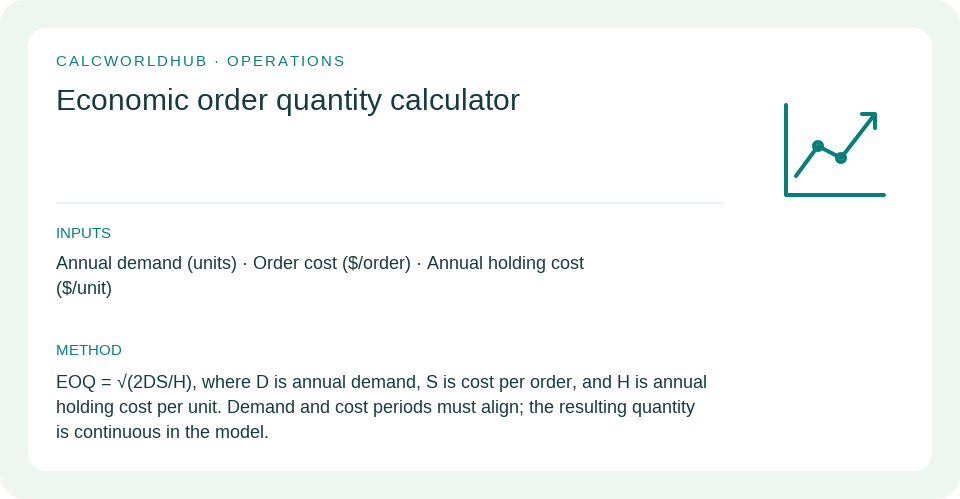
Estimate classical economic order quantity from annual demand, order cost, and annual holding cost.
- Enter Annual demand (units), Order cost ($/order), Annual holding cost ($/unit). Match the units shown beside each field and review the result together with the assumptions below.
- Read the worked example below to check the expected input format and result.
- Compare another scenario by changing one input at a time. Use Reset to return to the starting values.
Balance ordering effort with annual inventory holding cost
The classical economic order quantity estimates the order size that balances fixed cost per order against annual holding cost per unit. It is a baseline policy quantity rather than a schedule or stockout-risk estimate.
Inputs and units
- Annual demand (units): Expected demand per year in units.
- Order cost ($/order): Administrative or setup cost incurred for each replenishment order.
- Annual holding cost ($/unit): Cost to carry one unit for one year in dollars per unit-year.
Formula and method
EOQ = √(2DS/H), where D is annual demand, S is cost per order, and H is annual holding cost per unit. Demand and cost periods must align; the resulting quantity is continuous in the model.
Worked example
For D = 12,000 units/year, S = $35/order, and H = $2.50/unit-year, EOQ = √(2×12,000×35/2.50) = 579.66 units.
Interpreting the result
The model’s unconstrained order quantity is about 580 units. A practical order may need rounding for case packs, minimum quantities, shelf life, or storage limits.
Assumptions and limits
Classical EOQ assumes steady demand, known constant costs, no quantity discounts, no shortages, and replenishment arriving as a lot. It does not include lead time or safety stock.
Method references
Frequently asked questions
Why is working days per year not part of EOQ?
The EOQ quantity balances annual demand and annual holding cost; a workday calendar is needed only for timing or orders-per-year conversions.
How do I use the Economic order quantity calculator?
Enter Annual demand (units), Order cost ($/order), Annual holding cost ($/unit). Match the units shown beside each field and review the result together with the assumptions below.
What is a worked example of Economic order quantity?
For D = 12,000 units/year, S = $35/order, and H = $2.50/unit-year, EOQ = √(2×12,000×35/2.50) = 579.66 units.
What does the Economic order quantity calculator calculate?
Estimate classical economic order quantity from annual demand, order cost, and annual holding cost.
What assumptions apply to Economic order quantity?
Classical EOQ assumes steady demand, known constant costs, no quantity discounts, no shortages, and replenishment arriving as a lot. It does not include lead time or safety stock.
Good calculators show their work.
CalcWorldHub is built around clear inputs and visible assumptions. Results are estimates for planning; check official sources or your provider’s terms when exact figures matter.