How to use this calculator
Estimate how liquid compressibility and a thin elastic pipe wall set water-hammer wave speed, then compare valve closure time with the acoustic round trip.
- Enter Liquid bulk modulus (GPa), Liquid density (kg/m³), Pipe elastic modulus (GPa), Pipe internal diameter (m), then complete the remaining labeled fields. Match the units shown beside each field and review the result together with the assumptions below.
- Read the worked example below to check the expected input format and result.
- Compare another scenario by changing one input at a time. Use Reset to return to the starting values.
Elastic pipe water hammer wave speed and closure regime explained
Liquid compressibility and pipe-wall expansion jointly determine pressure-wave speed. Use that speed with the velocity change for the instantaneous Joukowsky pressure rise, and with line length for the acoustic round-trip time.
Inputs, symbols, and units
K— Liquid bulk modulus (GPa)- Compressibility modulus of the liquid without entrained gas.
rho— Liquid density (kg/m³)- Mass density used in acoustic speed and surge pressure.
E— Pipe elastic modulus (GPa)- Pipe material Young modulus for the stated thin-wall restraint approximation.
D— Pipe internal diameter (m)- Internal diameter.
t— Pipe wall thickness (m)- Wall thickness; the simplified thin-wall relation requires t less than D/10.
L— Pipe length to reflecting boundary (m)- Length used to estimate acoustic round-trip time.
dv— Velocity change magnitude (m/s)- Sudden mean-flow velocity reduction magnitude.
tc— Valve closure duration (s)- Actual closure duration, compared with acoustic round-trip time rather than used to fabricate a slow-closure surge formula.
Formula and method
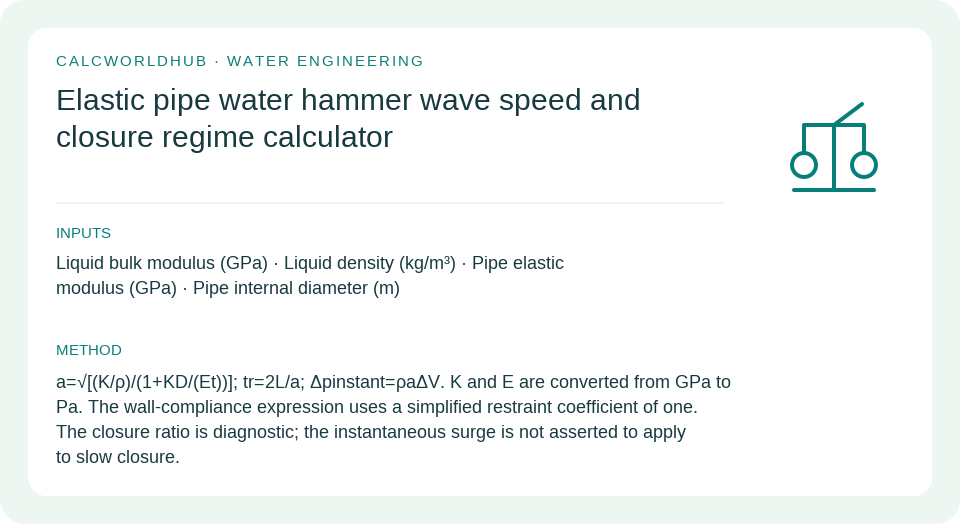
a=√[(K/ρ)/(1+KD/(Et))]; tr=2L/a; Δpinstant=ρaΔV. K and E are converted from GPa to Pa.
The wall-compliance expression uses a simplified restraint coefficient of one. The closure ratio is diagnostic; the instantaneous surge is not asserted to apply to slow closure.
A worked scenario
Liquid bulk modulus (GPa) = 2.2; Liquid density (kg/m³) = 1000; Pipe elastic modulus (GPa) = 200; Pipe internal diameter (m) = 0.3; Pipe wall thickness (m) = 0.006; Pipe length to reflecting boundary (m) = 500; Velocity change magnitude (m/s) = 1; Valve closure duration (s) = 1.
- Elastic pressure wave speed: 1191.366794 m/s
- Acoustic round-trip duration: 0.839372 s
- Instantaneous Joukowsky pressure rise: 1191.366794 kPa
- Closure to round-trip time ratio: 1.191367
Water with K=2.2 GPa in a 0.3 m diameter steel pipe with 6 mm wall and E=200 GPa has a lower wave speed than rigid-wall sound speed. A 500 m reach determines the reflection time.
Assumptions and edge cases
Thin elastic wall, simplified axial restraint, single-phase liquid and no gas pockets. Complex support conditions, viscoelasticity, cavitation and valve motion require transient analysis. Educational model; this is not a code-compliant design check.
Reading the outputs
Wave speed is m/s, round-trip time is seconds, instantaneous pressure rise is kPa and the closure-time ratio is dimensionless.
Frequently asked questions
Does the displayed pressure apply when closure is slow?
Not automatically. It is the instantaneous Joukowsky limit; a transient model is needed for actual slow valve motion.
Can trapped air be represented by changing density?
No. Gas pockets change compressibility and dynamics in ways this single-liquid model does not capture.
Why expose pipe elasticity?
Wall expansion stores volume and reduces pressure-wave speed relative to a rigid pipe.
How do I use the Elastic pipe water hammer wave speed and closure regime calculator?
Enter Liquid bulk modulus (GPa), Liquid density (kg/m³), Pipe elastic modulus (GPa), Pipe internal diameter (m), then complete the remaining labeled fields. Match the units shown beside each field and review the result together with the assumptions below.
What is a worked example of Elastic pipe water hammer wave speed and closure regime?
Liquid bulk modulus (GPa) = 2.2; Liquid density (kg/m³) = 1000; Pipe elastic modulus (GPa) = 200; Pipe internal diameter (m) = 0.3; Pipe wall thickness (m) = 0.006; Pipe length to reflecting boundary (m) = 500; Velocity change magnitude (m/s) = 1; Valve closure duration (s) = 1. Elastic pressure wave speed: 1191.366794 m/s Acoustic round-trip duration: 0.839372 s Instantaneous Joukowsky pressure rise: 1191.366794 kPa Closure to round-trip time ratio: 1.191367 Water with K=2.2 GPa in a 0.3 m diameter steel pipe with 6 mm wall and E=200 GPa has a lower wave speed than rigid-wall sound speed. A 500 m reach determines the reflection time.
Background or definition reference: USACE HEC-RAS Hydraulic Reference Manual.
Reference access note: The linked HEC-RAS reference PDF was not retrievable during this review. The stated equation and numerical example were checked independently; verify against current official hydraulic guidance before design use.
Read our calculation methodology.