How to use this calculator
Estimate the first ideal water-level rise and oscillation period in a simple open surge tank after instantaneous demand shutdown.
- Enter Supply conduit length (m), Supply conduit flow area (m²), Surge tank free-surface area (m²), Initial conduit velocity (m/s). Match the units shown beside each field and review the result together with the assumptions below.
- Read the worked example below to check the expected input format and result.
- Compare another scenario by changing one input at a time. Use Reset to return to the starting values.
Ideal surge tank oscillation after instantaneous shutdown explained
After an instantaneous shutdown, moving water in the supply conduit exchanges momentum with the free surface in the surge tank. This ideal small-oscillation model estimates the first maximum rise and quarter-period, with no friction or valve-closure transient.
Inputs, symbols, and units
L— Supply conduit length (m)- Length of the rigid water column feeding the surge tank.
Ap— Supply conduit flow area (m²)- Constant conduit cross-section.
As— Surge tank free-surface area (m²)- Constant plan area of the surge tank.
V0— Initial conduit velocity (m/s)- Velocity immediately before instantaneous downstream demand shutdown.
Formula and method
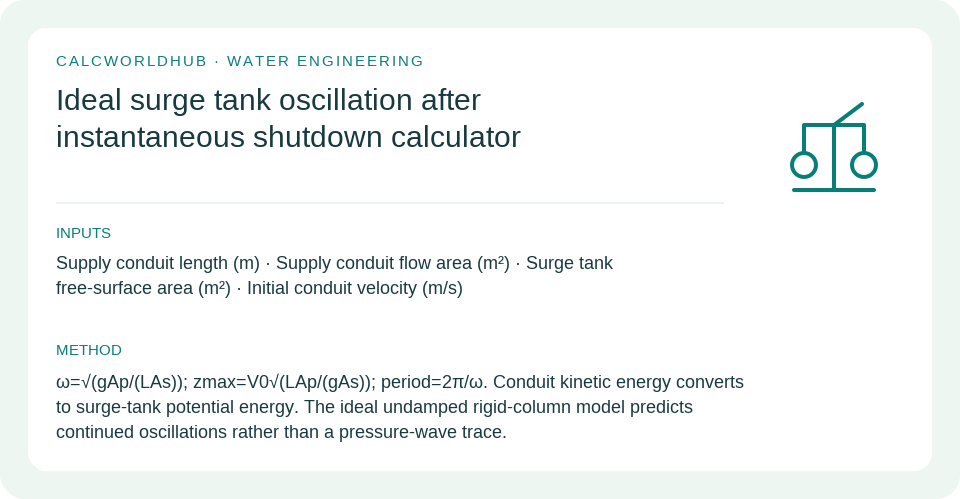
ω=√(gAp/(LAs)); zmax=V0√(LAp/(gAs)); period=2π/ω.
Conduit kinetic energy converts to surge-tank potential energy. The ideal undamped rigid-column model predicts continued oscillations rather than a pressure-wave trace.
A worked scenario
Supply conduit length (m) = 1000; Supply conduit flow area (m²) = 1; Surge tank free-surface area (m²) = 20; Initial conduit velocity (m/s) = 2.
- Ideal maximum surge level rise: 4.516008 m
- Small-oscillation period: 283.749123 s
- Time to first maximum: 70.937281 s
A 1000 m conduit of 1 m² area initially flowing at 2 m/s feeds a 20 m² surge tank. The ideal first rise is about 4.516 m.
Assumptions and edge cases
Rigid incompressible conduit, no friction or throttle, small oscillations, fixed upstream reservoir and instantaneous demand stop. Acoustic water hammer is a separate faster phenomenon. Educational model; this is not a code-compliant design check.
Reading the outputs
Maximum rise is m; the full period and time to the first maximum are seconds.
Frequently asked questions
Is this the water-hammer peak pressure?
No. It describes free-surface mass surge after an ideal shutdown, not high-frequency elastic pressure waves.
Does friction matter?
Yes. It damps and can shift the real oscillation; this energy model omits it.
Can the result size a final tank?
No. Overflow, minimum level, operating cases and coupled transient behavior must also be evaluated.
How do I use the Ideal surge tank oscillation after instantaneous shutdown calculator?
Enter Supply conduit length (m), Supply conduit flow area (m²), Surge tank free-surface area (m²), Initial conduit velocity (m/s). Match the units shown beside each field and review the result together with the assumptions below.
What is a worked example of Ideal surge tank oscillation after instantaneous shutdown?
Supply conduit length (m) = 1000; Supply conduit flow area (m²) = 1; Surge tank free-surface area (m²) = 20; Initial conduit velocity (m/s) = 2. Ideal maximum surge level rise: 4.516008 m Small-oscillation period: 283.749123 s Time to first maximum: 70.937281 s A 1000 m conduit of 1 m² area initially flowing at 2 m/s feeds a 20 m² surge tank. The ideal first rise is about 4.516 m.
Read our calculation methodology.