How to use this calculator
Estimate wall-to-battery charging efficiency, energy losses, and the electricity cost of those losses.
- Enter Energy drawn from wall (kWh), Energy added to battery (kWh), Electricity rate ($/kWh). Match the units shown beside each field and review the result together with the assumptions below.
- Read the worked example below to check the expected input format and result.
- Compare another scenario by changing one input at a time. Use Reset to return to the starting values.
How this calculation works
A charging session draws electricity from the supply while a smaller amount may be stored in the vehicle battery. Comparing measured wall energy with the battery’s increase in stored energy estimates the session’s energy efficiency and the difference attributable to charging losses.
Inputs and units
wallKwh— Energy drawn from wall (kWh)- Metered input energy for the charging session.
storedKwh— Energy added to battery (kWh)- Estimated increase in battery-stored energy over the same session.
rate— Electricity rate ($/kWh)- Optional tariff used to estimate the cost associated with energy loss.
Formula
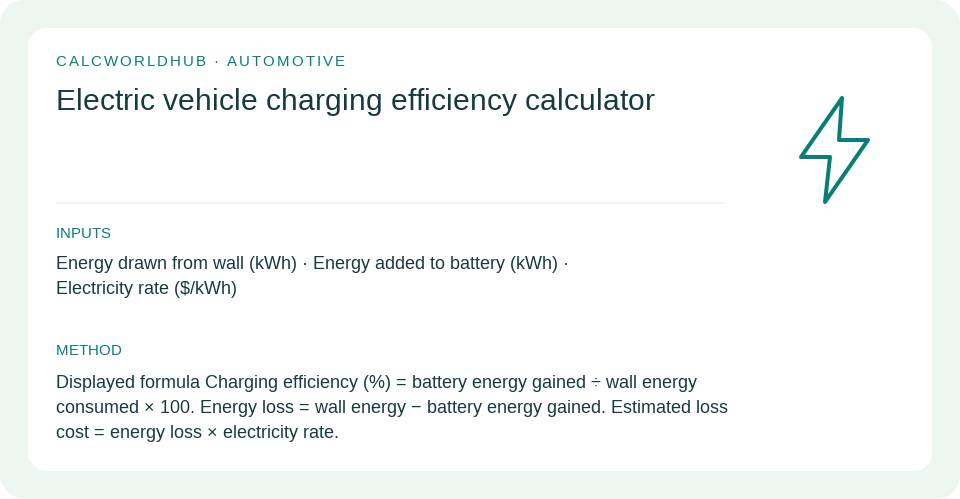
Charging efficiency (%) = battery energy gained ÷ wall energy consumed × 100. Energy loss = wall energy − battery energy gained. Estimated loss cost = energy loss × electricity rate.
Method
Enter wall energy from the charger or meter and the battery-energy increase for the same session. Use kWh for both; include the electricity price only if you want an estimated cost for the loss.
Worked example
If a session draws 30 kWh from the wall and the battery gains 27 kWh, estimated efficiency is 27 ÷ 30 × 100 = 90%. The 3 kWh difference costs $0.54 at $0.18/kWh.
Assumptions and limits
The estimate depends on how battery energy gain is measured. State-of-charge displays may be rounded, and temperature conditioning, battery heating, vehicle standby, charger overhead, and meter boundaries affect the result. It does not diagnose a charger or battery fault.
Frequently asked questions
Can this measure the charger’s efficiency alone?
No. The difference can include vehicle systems and battery conditioning, not just the charger electronics.
Why may displayed battery energy be inaccurate?
State-of-charge readings are often rounded or estimated; a suitable meter and matched session boundary improve the estimate.
Is 100% charging efficiency realistic?
The calculator permits it as a boundary case, but real-world losses can occur between the supply meter and stored battery energy.
How do I use the Electric vehicle charging efficiency calculator?
Enter Energy drawn from wall (kWh), Energy added to battery (kWh), Electricity rate ($/kWh). Match the units shown beside each field and review the result together with the assumptions below.
What is a worked example of Electric vehicle charging efficiency?
If a session draws 30 kWh from the wall and the battery gains 27 kWh, estimated efficiency is 27 ÷ 30 × 100 = 90%. The 3 kWh difference costs $0.54 at $0.18/kWh.
Read our calculation methodology.