How to use this calculator
Estimate battery energy and ideal charging duration between two state-of-charge targets.
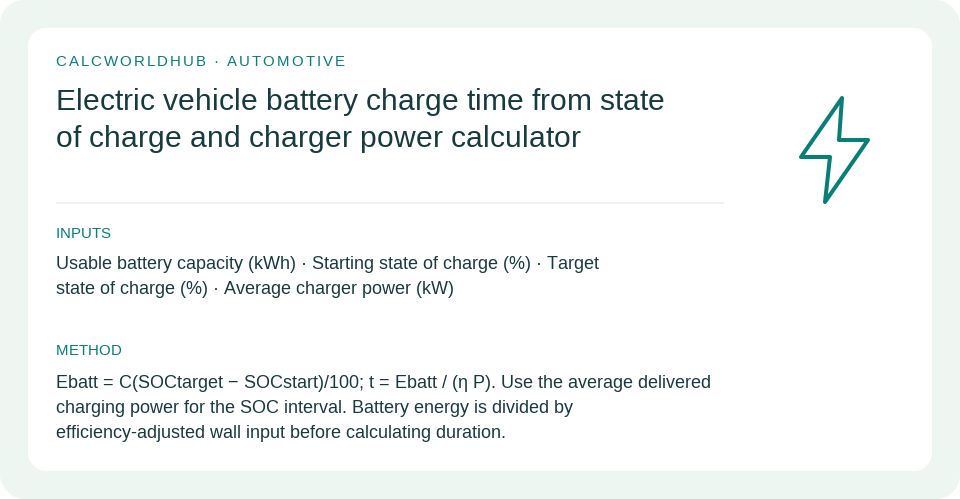
- Enter Usable battery capacity (kWh), Starting state of charge (%), Target state of charge (%), Average charger power (kW), then complete the remaining labeled fields. Match the units shown beside each field and review the result together with the assumptions below.
- Read the worked example below to check the expected input format and result.
- Compare another scenario by changing one input at a time. Use Reset to return to the starting values.
Electric vehicle battery charge time from state of charge and charger power explained
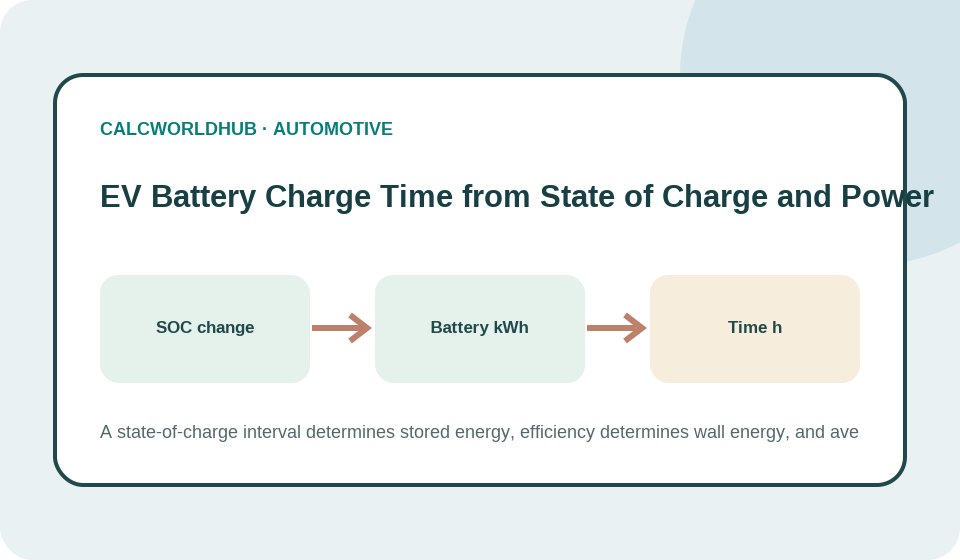
The stored energy needed is usable capacity multiplied by the requested state-of-charge increase. Dividing by average charger power times wall-to-battery efficiency estimates elapsed charging time; real charging curves usually taper near high state of charge.
Inputs, symbols, and units
capacity— Usable battery capacity (kWh)- Energy capacity available for charging.
start— Starting state of charge (%)- Battery state at the beginning of the session.
target— Target state of charge (%)- Desired state at the end of the session.
power— Average charger power (kW)- Average power actually delivered during this interval.
eff— Wall-to-battery efficiency (%)- Fraction of input electricity stored in the battery.
Formula and method
Ebatt = C(SOCtarget − SOCstart)/100; t = Ebatt / (η P).
Use the average delivered charging power for the SOC interval. Battery energy is divided by efficiency-adjusted wall input before calculating duration.
A worked scenario
Usable battery capacity (kWh) = 70; Starting state of charge (%) = 20; Target state of charge (%) = 80; Average charger power (kW) = 11; Wall-to-battery efficiency (%) = 90.
- Battery energy added: 42 kWh
- Estimated charging time: 4.242424 h
- Wall energy drawn: 46.666667 kWh
A 70 kWh usable pack moving from 20% to 80% needs 42 kWh stored; at 11 kW and 90% efficiency, the ideal estimate is 4.24 hours.
Assumptions and edge cases
Constant average power is assumed. Charging taper, thermal conditioning, balancing, station sharing, and vehicle limits can extend actual time.
Reading the outputs
The main result is EV charging time in hours; supporting outputs are labeled with their own units. Use the units shown beside each input and result.
Frequently asked questions
What does the electric vehicle battery charge time from state of charge and charger power calculate?
A 70 kWh usable pack moving from 20% to 80% needs 42 kWh stored; at 11 kW and 90% efficiency, the ideal estimate is 4.24 hours.
Which inputs most affect ev charging time in hours?
Use the average delivered charging power for the SOC interval. Battery energy is divided by efficiency-adjusted wall input before calculating duration.
Can this result replace a site-specific or measured value?
Constant average power is assumed. Charging taper, thermal conditioning, balancing, station sharing, and vehicle limits can extend actual time.
How do I use the Electric vehicle battery charge time from state of charge and charger power calculator?
Enter Usable battery capacity (kWh), Starting state of charge (%), Target state of charge (%), Average charger power (kW), then complete the remaining labeled fields. Match the units shown beside each field and review the result together with the assumptions below.
What is a worked example of Electric vehicle battery charge time from state of charge and charger power?
Usable battery capacity (kWh) = 70; Starting state of charge (%) = 20; Target state of charge (%) = 80; Average charger power (kW) = 11; Wall-to-battery efficiency (%) = 90. Battery energy added: 42 kWh Estimated charging time: 4.242424 h Wall energy drawn: 46.666667 kWh A 70 kWh usable pack moving from 20% to 80% needs 42 kWh stored; at 11 kW and 90% efficiency, the ideal estimate is 4.24 hours.
Read our calculation methodology.