How to use this calculator
Compare measured plating mass with the theoretical Faraday-law metal deposit.
- Enter Measured deposited metal mass (g), Average cathode current (A), Plating time (hours), Deposited metal molar mass (g/mol), then complete the remaining labeled fields. Match the units shown beside each field and review the result together with the assumptions below.
- Read the worked example below to check the expected input format and result.
- Compare another scenario by changing one input at a time. Use Reset to return to the starting values.
How this calculation works
Cathode current efficiency compares the actual metal deposited with the theoretical metal amount predicted from electric charge and electrochemical stoichiometry. The theoretical mass follows Faraday's law using the metal molar mass and the number of electrons required per deposited ion.
Inputs and units
actualMassG— Measured deposited metal mass (g)- Net mass increase attributable to deposited metal for the entered run.
currentA— Average cathode current (A)- Average current that passed through the plating cell during the run.
timeHours— Plating time (hours)- Elapsed time over which the entered average current was maintained.
molarMassGmol— Deposited metal molar mass (g/mol)- Molar mass of the plated metal, for example copper 63.546 g/mol.
valence— Electrons per deposited metal ion (z)- Positive charge number in the metal-deposition half-reaction.
Formula
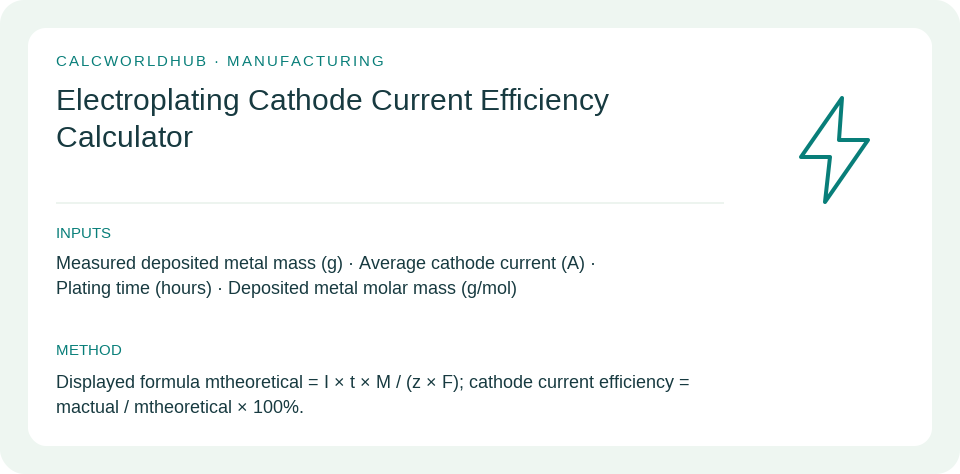
mtheoretical = I × t × M / (z × F); cathode current efficiency = mactual / mtheoretical × 100%.
Method
Use the net deposited metal mass, total current through the bath, elapsed plating time, metal molar mass, and the ionic charge number for the depositing reaction. Convert elapsed hours to seconds and compare measured mass with the Faraday-law theoretical mass.
Worked example
At 5 A for 1 hour, copper (63.546 g/mol) with z = 2 has a theoretical deposit of about 5.93 g. A measured 4.50 g corresponds to about 75.9% cathode current efficiency.
Assumptions and limits
The estimate assumes the entered current and time represent the same plating interval and the stated ion valence is the depositing reaction. Mass measurement, side reactions, current distribution, alloy codeposition, and changing current can affect the result. Values above 100% signal inconsistent inputs or assumptions.
Frequently asked questions
What does current efficiency compare?
It compares the measured deposited metal mass with the theoretical Faraday-law mass for the same current and time.
Why can efficiency be below 100%?
Some applied current may drive side reactions instead of depositing the target metal.
What if the result is above 100%?
Review the mass basis, current, duration, molar mass, and ionic valence; the entered values exceed the theoretical Faraday deposit.
How do I use the Electroplating Cathode Current Efficiency Calculator?
Enter Measured deposited metal mass (g), Average cathode current (A), Plating time (hours), Deposited metal molar mass (g/mol), then complete the remaining labeled fields. Match the units shown beside each field and review the result together with the assumptions below.
What is a worked example of Electroplating Cathode Current Efficiency?
At 5 A for 1 hour, copper (63.546 g/mol) with z = 2 has a theoretical deposit of about 5.93 g. A measured 4.50 g corresponds to about 75.9% cathode current efficiency.
Reference: U.S. EPA AP-42 electroplating Faraday-law electrochemical equivalent and cathode efficiency. See our calculation methodology.