How to use this calculator
Estimate paid absence and replacement coverage labor costs from missed hours and your entered pay assumptions.
- Enter Scheduled absence hours, Absence hours paid (%), Fully burdened labor cost per hour ($), Absence hours covered by replacement (%), then complete the remaining labeled fields. Match the units shown beside each field and review the result together with the assumptions below.
- Read the worked example below to check the expected input format and result.
- Compare another scenario by changing one input at a time. Use Reset to return to the starting values.
How this calculation works
This worksheet separates the cost of paid scheduled absence from the direct cost of replacement coverage. It can help an organization make its assumptions visible, but it does not value lost output, customer impact, morale, or other indirect effects.
Inputs and units
hours— Scheduled absence hours- Total scheduled work hours missed during the period.
paidShare— Absence hours paid (%)- Share of absent hours still paid, from 0% to 100%.
hourly— Fully burdened labor cost per hour ($)- Hourly cost basis including the burden you choose to include.
coverageShare— Absence hours covered by replacement (%)- Share of missed hours covered by another worker or temporary staff.
premium— Replacement coverage premium (%)- Extra percentage above the entered hourly cost for covered hours.
Formula
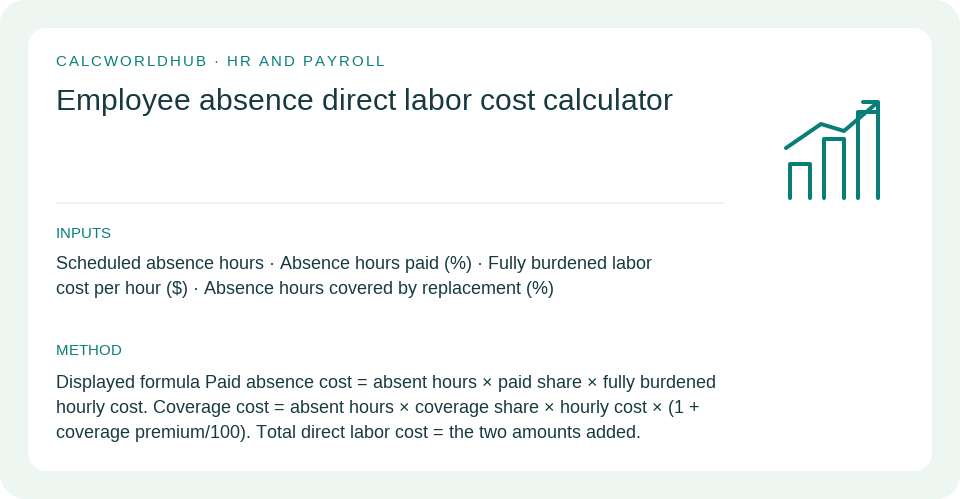
Paid absence cost = absent hours × paid share × fully burdened hourly cost. Coverage cost = absent hours × coverage share × hourly cost × (1 + coverage premium/100). Total direct labor cost = the two amounts added.
Method
Enter absent scheduled hours, the share paid during absence, fully burdened labor cost per hour, the share of hours replaced, and any premium above the normal hourly cost for replacement coverage. Percent inputs use percentage points.
Worked example
For 120 absent hours, $32 fully burdened cost/hour, 100% paid leave, 60% replacement coverage, and a 50% coverage premium, paid absence is $3,840 and replacement coverage is $3,456, for $7,296 direct labor cost.
Assumptions and limits
This estimate reflects only the entered direct labor assumptions. Paid leave rules, collective agreements, exempt status, payroll taxes, productivity effects, and replacement staffing vary. Do not treat the result as a legal payroll calculation or an employee-level performance measure.
Frequently asked questions
Does the total include lost productivity?
No. It adds only the paid absence and replacement labor components entered.
What does fully burdened hourly cost mean?
It is the hourly cost basis you choose, potentially including wage, payroll burden, and benefits; apply the same basis consistently.
Can coverage exceed 100% of absent hours?
This model caps the covered share at 100%; enter direct replacement hours separately in a different analysis if they exceed missed hours.
Is this suitable for calculating employee discipline or individual cost?
No. It is a planning estimate for aggregate staffing assumptions and does not measure an individual employee's performance.
How do I use the Employee absence direct labor cost calculator?
Enter Scheduled absence hours, Absence hours paid (%), Fully burdened labor cost per hour ($), Absence hours covered by replacement (%), then complete the remaining labeled fields. Match the units shown beside each field and review the result together with the assumptions below.
Read our calculation methodology.