How to use this calculator
Test a specified population median from the signs of observations, without using their distances from that median.
- Enter Observed values, Null median. Match the units shown beside each field and review the result together with the assumptions below.
- Read the worked example below to check the expected input format and result.
- Compare another scenario by changing one input at a time. Use Reset to return to the starting values.
Exact one sample median sign test explained
The exact sign test compares how many independent observations fall above and below a prespecified median. It ignores the distances from that median, excludes exact ties, and obtains a two-sided probability from a binomial distribution.
Inputs, symbols, and units
x— Observed values- Independent measurements or one difference per matched pair. Use the same measurement unit as the null median. Use comma-separated values in the stated order.
m— Null median- Prespecified null population median, in the measurement unit of x. Exact ties to this value are excluded.
Formula and method
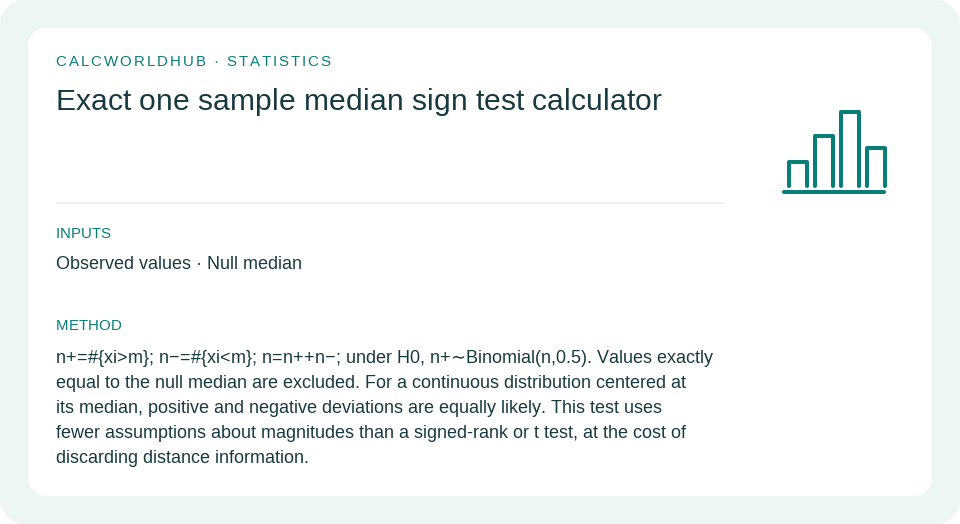
n+=#{xi>m}; n−=#{xi<m}; n=n++n−; under H0, n+∼Binomial(n,0.5).
Values exactly equal to the null median are excluded. For a continuous distribution centered at its median, positive and negative deviations are equally likely. This test uses fewer assumptions about magnitudes than a signed-rank or t test, at the cost of discarding distance information.
A worked scenario
Observed values = 12,14,9,15,13,17,10,16; Null median = 11.
- Exact two-sided sign-test p-value: 0.2890625
- Positive deviations: 6
- Negative deviations: 2
- Excluded ties: 0
The example compares eight measurements with a median of eleven. Six lie above and two below, so only that 6-to-2 sign count drives the exact result.
Assumptions and edge cases
Independent observations and a meaningful median null. At most 2,000 values. Ties are removed rather than split; with a discrete distribution, this convention needs care.
Reading the outputs
The result is a two-sided exact probability-ordering p-value. Counts of positive, negative, and excluded tied observations show the effective sample size.
Frequently asked questions
Can I enter paired differences?
Yes. Form one difference per independent pair and test a null median difference, usually zero.
Will changing an extreme positive value matter?
Not unless it crosses the null median; its magnitude is ignored.
Is the sign test a test of the mean?
No. Its null concerns the median or balanced positive/negative deviations.
How do I use the Exact one sample median sign test calculator?
Enter Observed values, Null median. Match the units shown beside each field and review the result together with the assumptions below.
What is a worked example of Exact one sample median sign test?
Observed values = 12,14,9,15,13,17,10,16; Null median = 11. Exact two-sided sign-test p-value: 0.2890625 Positive deviations: 6 Negative deviations: 2 Excluded ties: 0 The example compares eight measurements with a median of eleven. Six lie above and two below, so only that 6-to-2 sign count drives the exact result.
Method reference: SciPy exact binomial test.
Read our calculation methodology.