How to use this calculator
Evaluate a paired mean difference by enumerating sign reversals while preserving the magnitude of each observed pair difference.
- Enter Paired differences. Match the units shown beside each field and review the result together with the assumptions below.
- Read the worked example below to check the expected input format and result.
- Compare another scenario by changing one input at a time. Use Reset to return to the starting values.
Exact paired mean sign flip test explained
Under a symmetric zero-difference null, each observed paired difference can take either sign. This test enumerates all 2ⁿ assignments and counts those at least as extreme as the observed mean.
A numerical walkthrough
Paired differences = 2,3,-1,4,2,-2.
- Exact paired sign-flip p-value: 0.28125
- Mean paired difference: 1.33333333 data units
- Sign assignments enumerated: 64
Six paired differences give sixty-four sign assignments. A difference of four contributes twice the magnitude of a difference of two under each chosen sign.
The model behind the numbers
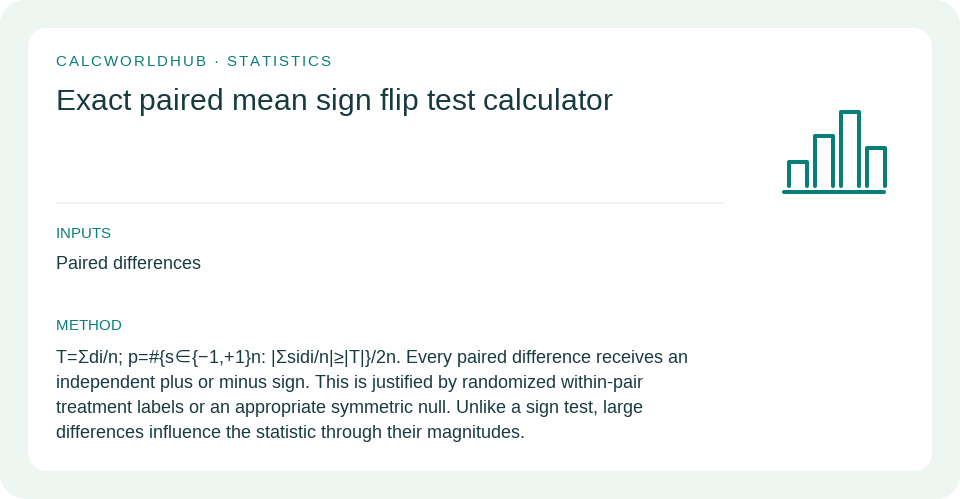
T=Σdi/n; p=#{s∈{−1,+1}n: |Σsidi/n|≥|T|}/2n.
Every paired difference receives an independent plus or minus sign. This is justified by randomized within-pair treatment labels or an appropriate symmetric null. Unlike a sign test, large differences influence the statistic through their magnitudes.
What to enter
d— Paired differences- One consistently oriented paired difference per independent pair, such as after minus before. At most 18 differences. Use comma-separated values in the stated order.
Interpreting the result
2–18 independent paired differences. Sign-flip validity is stronger than a null mean of zero alone; it generally requires exchangeable within-pair labels or symmetric errors. All sign assignments, including zero-difference duplicates, are counted.
Reading the outputs
The exact absolute-tail p-value is based on the observed mean magnitude. It is distinct from a signed-rank test and from counting positive differences alone.
Frequently asked questions
Should I enter before and after as separate lists?
Compute a consistent difference, such as after minus before, for each matched pair first.
Are zero differences allowed?
Yes. Their sign does not change the mean, but both assignments remain part of the enumeration.
Why does this differ from the sign test?
The sign test discards magnitudes; this test retains them.
How do I use the Exact paired mean sign flip test calculator?
Enter Paired differences. Match the units shown beside each field and review the result together with the assumptions below.
What is a worked example of Exact paired mean sign flip test?
Paired differences = 2,3,-1,4,2,-2. Exact paired sign-flip p-value: 0.28125 Mean paired difference: 1.33333333 data units Sign assignments enumerated: 64 Six paired differences give sixty-four sign assignments. A difference of four contributes twice the magnitude of a difference of two under each chosen sign.
Method reference: SciPy permutation null models; this page states its own absolute-tail convention.
Read our calculation methodology.