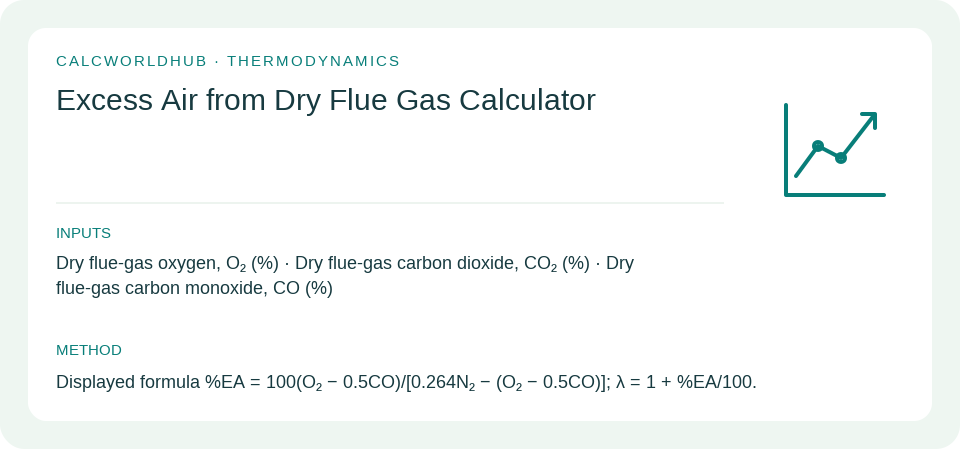
How to use this calculator
Estimate combustion excess air and air ratio from dry flue-gas oxygen and carbon monoxide readings.
- Enter Dry flue-gas oxygen, O₂ (%), Dry flue-gas carbon dioxide, CO₂ (%), Dry flue-gas carbon monoxide, CO (%). Match the units shown beside each field and review the result together with the assumptions below.
- Read the worked example below to check the expected input format and result.
- Compare another scenario by changing one input at a time. Use Reset to return to the starting values.
How this calculation works
This dry-basis combustion check uses measured oxygen, carbon monoxide, and nitrogen to estimate excess combustion air. Nitrogen is inferred by difference when the entered dry-gas species form a complete analysis.
Inputs and units
oxygenPct— Dry flue-gas oxygen, O₂ (%)- Measured oxygen volume percentage on a dry basis.
carbonDioxidePct— Dry flue-gas carbon dioxide, CO₂ (%)- Measured carbon-dioxide volume percentage on a dry basis.
carbonMonoxidePct— Dry flue-gas carbon monoxide, CO (%)- Measured carbon-monoxide volume percentage on a dry basis.
Formula
%EA = 100(O₂ − 0.5CO)/[0.264N₂ − (O₂ − 0.5CO)]; λ = 1 + %EA/100.
Method
Enter dry-basis volume percentages for O₂, CO₂, and CO. Nitrogen is estimated as the balance to 100%. The calculation follows the EPA Method 3B excess-air equation and reports the air ratio λ.
Worked example
With dry flue gas of 3.0% O₂, 10.0% CO₂, and 0.2% CO, inferred N₂ is 86.8%; EPA Method 3B gives 14.49% excess air and λ = 1.1449.
Assumptions and limits
The equation assumes dry flue gas, ambient combustion air, and no appreciable fuel-bound nitrogen. It also assumes the listed dry-gas analysis is complete, so other species and measurement-basis corrections are not represented. Do not use it as a substitute for an emissions or safety determination.
Frequently asked questions
Why is nitrogen calculated by difference?
The method uses a complete dry-gas analysis and infers nitrogen as the remainder after the entered O₂, CO₂, and CO.
What does λ mean?
It is actual combustion air divided by theoretical air; λ above 1 corresponds to excess air.
Can I enter wet-basis readings?
No. The equation is applied to dry-basis readings; remove water vapor or use a method that accounts for wet gas.
How do I use the Excess Air from Dry Flue Gas Calculator?
Enter Dry flue-gas oxygen, O₂ (%), Dry flue-gas carbon dioxide, CO₂ (%), Dry flue-gas carbon monoxide, CO (%). Match the units shown beside each field and review the result together with the assumptions below.
What is a worked example of Excess Air from Dry Flue Gas?
With dry flue gas of 3.0% O₂, 10.0% CO₂, and 0.2% CO, inferred N₂ is 86.8%; EPA Method 3B gives 14.49% excess air and λ = 1.1449.
Reference: U.S. EPA Method 3B dry flue-gas excess-air equation and assumptions. See our calculation methodology.