How to use this calculator
Estimate an exoplanet atmosphere’s pressure scale height from temperature, mean particle mass, and surface gravity.
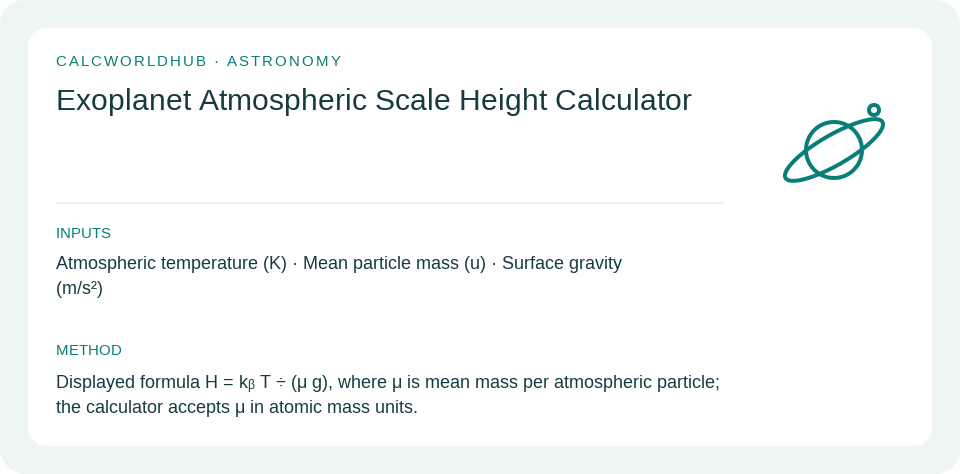
- Enter Atmospheric temperature (K), Mean particle mass (u), Surface gravity (m/s²). Match the units shown beside each field and review the result together with the assumptions below.
- Read the worked example below to check the expected input format and result.
- Compare another scenario by changing one input at a time. Use Reset to return to the starting values.
How this calculation works
In a hydrostatic atmosphere, the pressure scale height is the vertical distance over which pressure falls by a factor of e under an isothermal approximation. For an ideal gas, it depends on atmospheric temperature, particle mass, and gravity.
Inputs and units
temperatureK— Atmospheric temperature (K)- Representative atmospheric temperature in kelvin.
meanMassU— Mean particle mass (u)- Mean mass of an atmospheric particle in atomic mass units.
gravityMs2— Surface gravity (m/s²)- Planetary gravitational acceleration in metres per second squared.
Formula
H = kᵦ T ÷ (μ g), where μ is mean mass per atmospheric particle; the calculator accepts μ in atomic mass units.
Method
Enter atmospheric temperature in kelvin, mean molecular mass in atomic mass units per particle, and gravitational acceleration in metres per second squared. The calculator converts atomic mass units to kilograms and reports H in kilometres.
Worked example
At 1,200 K, mean particle mass 2.3 u, and gravity 10 m/s², the isothermal pressure scale height is about 433.8 km.
Assumptions and limits
This is an isothermal, hydrostatic scale-height estimate using constant gravity and a representative mean particle mass. It does not model temperature gradients, chemistry, clouds, escape, or wavelength-dependent transit spectra.
Frequently asked questions
What is a scale height?
It is the vertical distance over which pressure decreases by a factor of e in the stated atmospheric model.
Why enter mean particle mass?
The pressure scale height is inversely proportional to the mean mass of gas particles.
Does this calculate the atmospheric spectrum?
No. It estimates H only; spectral feature strength also depends on opacity, clouds, and wavelength.
How do I use the Exoplanet Atmospheric Scale Height Calculator?
Enter Atmospheric temperature (K), Mean particle mass (u), Surface gravity (m/s²). Match the units shown beside each field and review the result together with the assumptions below.
What is a worked example of Exoplanet Atmospheric Scale Height?
At 1,200 K, mean particle mass 2.3 u, and gravity 10 m/s², the isothermal pressure scale height is about 433.8 km.
Reference: NASA/STScI transmission-spectroscopy paper stating the hydrostatic atmospheric scale-height relation. See our calculation methodology.